The Duke’s Rise to Fame
Born on January 2, 1969, in Jay, Oklahoma, Tommy Morrison grew up in a family that prized toughness and fighting spirit. He was given the nickname “The Duke” due to his claim of being the grandnephew of Hollywood icon John Wayne. While that connection to Hollywood may have been disputed, Morrison’s natural talent inside the ring was undeniable.
Standing at 6 feet 2 inches, Morrison was a hard-hitting heavyweight known for his aggressive style, knockout power, and fast hands. By the late ‘80s, he was carving out a name for himself as a rising star in professional boxing. His pro debut came on November 10, 1988, when he scored a first-round knockout against William Muhammad in New York City. Just 20 days later, he notched another first-round KO, setting the tone for his explosive career.
By 1989, Morrison had 19 straight wins, with 15 by knockout, including victories over fighters who had previously gone toe-to-toe with Mike Tyson and George Foreman. His ferocity inside the ring had people talking—but so did his wild lifestyle outside of it.
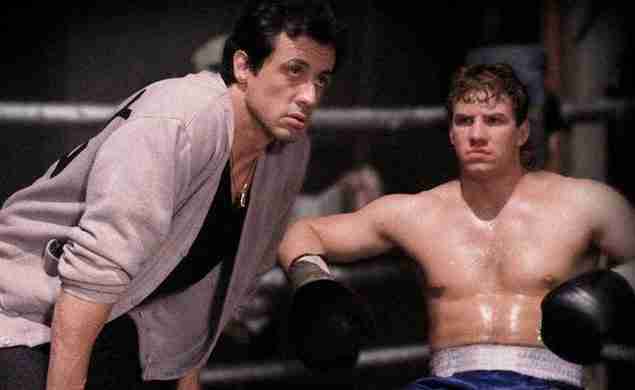
Tommy Morrison in Rocky V
Morrison’s big break didn’t come in the ring—but in Hollywood. During one of his fights in 1989, Sylvester Stallone was in the audience, scouting for someone to play Rocky Balboa’s protégé-turned-rival in Rocky V. Morrison’s raw energy and natural charisma caught his attention.
Stallone arranged a script reading for Morrison, and soon after, he landed the role of Tommy “The Machine” Gunn, a hungry young fighter who turns on his mentor. The film, released in December 1990, gave Morrison mainstream recognition, introducing him to audiences beyond boxing.
While Rocky V had mixed reviews, Morrison’s performance was widely considered one of the film’s stronger elements. His on-screen presence, combined with his real-life boxing ability, made him a convincing antagonist. However, Hollywood wasn’t his true calling—Morrison belonged in the ring.
The Highs and Lows of His Boxing Career
By 1991, Morrison was back to focusing on boxing, racking up wins and positioning himself for a shot at the heavyweight title. That same year, he squared off against Ray Mercer for the WBO heavyweight championship, but suffered a brutal fifth-round knockout in a highlight-reel moment.
Undeterred, Morrison continued his climb, securing six victories in 1992, including a win over future world title challenger Joe Hipp. His biggest moment came on June 7, 1993, when he faced George Foreman for the WBO heavyweight title. Against the odds, Morrison outboxed the legendary Foreman over 12 rounds, winning the championship and proving himself as a legitimate force in the division.
Unfortunately, Morrison’s reign didn’t last long. Just a few months later, he was knocked out in the first round by Michael Bentt, in what was considered a massive upset. He bounced back with solid wins, including a memorable 1995 war against Razor Ruddock, but when he finally got his long-awaited showdown with Lennox Lewis, he was stopped in six rounds.
While Morrison had all the tools to be great, his lack of discipline outside the ring cost him dearly. His partying, drinking, and reckless lifestyle led to inconsistent performances, and many believe he never reached his full potential.
The HIV Diagnosis That Changed Everything
In 1996, just days before a scheduled fight, Morrison underwent mandatory HIV testing with the Nevada State Athletic Commission. The results came back positive.
The shocking revelation ended his boxing career instantly. Showtime’s broadcast team announced during their fight coverage that Morrison had already boarded a plane back to Oklahoma, effectively forced into retirement.
Morrison later addressed the diagnosis, blaming his condition on “a fast lifestyle”, a reference to his well-documented indulgences in women and partying. He attempted a short-lived comeback, fighting one last time in Tokyo, knocking out Marcus Rhodes in the first round before leaving the sport for good. His final professional record stood at 46 wins, 3 losses, and 1 draw, with 40 knockouts.
A Troubled Life Outside the Ring
Retirement didn’t bring peace. Morrison’s post-boxing years were filled with legal troubles, failed business ventures, and erratic behavior. He spent 14 months in prison on drug and weapons charges, and despite his earlier admission, he later denied ever having HIV, claiming the tests were inaccurate and that he had been the victim of a conspiracy.
Despite his troubled personal life, Morrison had a family. He was married multiple times, with his last known spouse being Trisha Morrison. He also had children, including his son, Tristin Duke Morrison, who carries on his father’s name.
In later years, Morrison reached out to Sylvester Stallone, hoping to be involved in Rocky Balboa (2006), but nothing materialized. He also attempted to publish an autobiography, though it never found a publisher.
Tommy Morrison’s Final Days and Death
By 2011, Morrison’s health had visibly declined. Once a chiseled, powerful athlete, he had become frail and unrecognizable. His wife Trisha publicly denied that he had AIDS, but his deteriorating condition painted a different picture.
For the last year of his life, Morrison was bedridden, suffering from septic shock, cardiac arrest, and organ failure. His once-powerful body had wasted away, and he was no longer the fighter fans remembered from his glory days.
On September 1, 2013, at just 44 years old, Tommy Morrison passed away in Omaha, Nebraska. His official cause of death was listed as septicemia, Pseudomonas aeruginosa, and multi-organ failure, but the complications from AIDS were undeniable.
His funeral was held in Butler Creek Cemetery in Sulphur Springs, Arkansas, where he was laid to rest.
Tommy Morrison’s Legacy: A What-If Story
To this day, Morrison’s career is viewed as one of boxing’s greatest “what-if” stories. He had the power, the talent, and the stage to become a long-reigning champion, but his lack of discipline and off-the-ring choices kept him from reaching his full potential.
He was never seen as an all-time great, but his knockout power was undeniable. His victories over George Foreman and Razor Ruddock proved he was more than just a Hollywood fighter—he could hang with the best. However, when compared to legends like Tyson, Holyfield, or Lewis, Morrison’s career was defined by what could have been.
Outside of boxing, he remains a well-known figure in pop culture for his role in Rocky V. His character, Tommy Gunn, became a cautionary tale in the film—a talented fighter who let fame and ego destroy his career, a story that mirrored Morrison’s real-life struggles.
Though his life was cut short, Tommy Morrison’s name still sparks discussion among boxing and Rocky fans alike. Whether remembered as a fighter, an actor, or a tragic figure, his story is one of potential, power, and ultimately, downfall.