“Whatever he hits, he destroys.” Nikolai Koloff
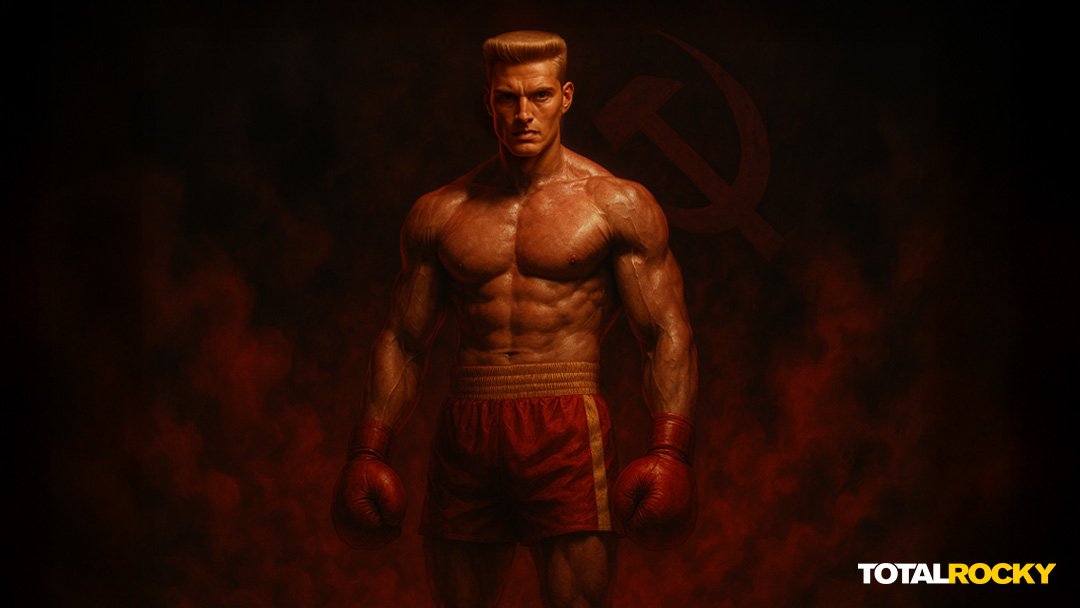
In the world of Rocky no villain looms larger than Ivan Drago. Introduced as “The Siberian Express” in Rocky IV, Drago became the franchise’s most unforgettable threat. Actor Dolph Lundgren brought him to life with ruthless silence and mechanical precision. His portrayal left a cold imprint on pop culture, returning decades later in Creed II to continue the legacy.
But to fans, Drago is more than a character—he’s a symbol of raw, focused power.
From the Slums of Moscow to the Soviet Spotlight
Ivan Drago was born in the slums of Moscow in the late 1950s. His father was an alcoholic, drifting from job to job. His mother sold tarts in a Russian flea market, scraping together what little she could. From them, Drago learned survival. He studied how to exploit weaknesses and work every angle to his benefit.
As a teenager, Drago turned to crime. He began as a pickpocket, then moved on to burglary. It paid better and kept his pockets full. Eventually, he discovered the black market, which opened bigger opportunities. He traded cheap vodka and scavenged clothes to drunken Finnish tourists in exchange for their designer outfits. He was sharp, learning quickly despite being a poor student. His teachers were stunned by his hustle.
Drago’s size and strength helped him rise fast in the underground. As a growing fartsoushcik, he moved currency, sold banned books, and even passed fake bills. Competitors feared him. He didn’t need muscle—he was the muscle. Ivan Drago was already building his myth long before boxing found him.
From Black Market Muscle to Coal Dust
Drago’s rise as a black market powerhouse was almost derailed. One of his closest friends was arrested for selling a banned copy of “Lolita”. The Soviet government didn’t just seize the book—they charged him under Article 58-10. Ten years in a labor camp. That shook Drago to his core.
He made a choice. No more illegal trade. He took a job at the Red Proletarian Factory, hoping to disappear into the working class. But a dispute with a Party-connected foreman ended that fast. As punishment, he was reassigned to a coal mine outside Voroshilovgrad. It was hard, filthy work—perfect for someone like him.
That’s where the real twist happened. A film crew from the Moscow Film Institute came to document the lives of proletariat workers. When they saw the impressive-looking Drago covered in sweat and coal, they didn’t see a miner. They saw a symbol. A superhuman. One look at him, and the camera started rolling.
The footage made its way back to Moscow. And the machine took notice.
Engineered to Win: Captain Ivan Drago’s Rise Through Soviet Athletics
Before he became the Soviet Union’s prized boxer, Ivan Drago served in the military. He held the rank of Captain in the Soviet Army—a title confirmed by his dress uniform, visible at public events and press conferences. The red-and-gold insignia on his epaulets, along with his Hero of the Soviet Union star, marked him as more than a fighter. He was a symbol crafted for international display.
Whether Drago joined the military willingly or was drafted is unclear. What’s certain is that his power didn’t go unnoticed. Soviet leadership recognized more than just a soldier—they saw raw potential for propaganda. He was pulled from active service and placed under government control, moved into a cramped apartment near a training facility, and handed over to the state sports system.
His transformation began under Manuel Vega, a Cuban coach known for his ruthless discipline. Later, Drago trained under Igor Rimsky, who took the program even further. Every second of Drago’s life was monitored. Electrodes mapped his performance. Machines logged his stats. His strength, speed, and recovery times were studied like military hardware. He wasn’t living—he was testing.
Media in the West called him a machine. Behind the Iron Curtain, that wasn’t far from the truth. Drago had lost his identity. What remained was pure function, all muscle and obedience. But deep down, he never forgot what he wanted. He wasn’t fighting for politics. He was fighting to prove he was better than the man who made him fall in love with boxing in the first place—Rocky Balboa.
Ludmilla Drago: The Steel Behind the Stone
Drago met Ludmilla at the 1980 Olympics in Moscow. She wasn’t assigned to him. She chose him. Unlike others around him, she saw more than muscle and numbers. She saw a future. He saw someone who made him feel human.
Ludmilla came from a polished world of media training and political maneuvering. Drago came from coal and crime. Somehow, they clicked. With her, his cold rage melted—just enough. She likely taught him poise, discipline, and how to navigate the spotlight. He gave her devotion. She became the only person he truly cared about.
Ivan would do anything to protect her. That loyalty made him dangerous. Not reckless. Focused. She wasn’t just his wife. She was his reason.
The Siberian Express Lands in America
Drago arrived in the United States on an Aeroflot flight out of Orly. The Soviet entourage was massive—scientists, trainers, handlers, and Ludmilla.
In press conferences, Drago stood like a statue. Immense, broad-shouldered, with a body straining against his tailored suit. His blond hair gleamed under the lights, and his face looked like it had been carved from steel. The emotionless stare from his gray eyes said everything the Soviet Union wanted to project—control, confidence, and complete domination.
He didn’t speak much English, but understood enough. When asked if he had fought real professionals, Ludmilla answered for him. “He has not fought anyone professionally,” she said. “But he trained in Russia and Cuba under Manuel Vega and now Igor Rimsky. We believe he is more than qualified.”
Rimsky echoed that. “He is the most perfect athlete in the world,” he said. “No one can match his strength, endurance, or focus.”
The press didn’t know what to make of him. He wasn’t charming. He wasn’t loud. He was built for one thing—combat.
Ivan Drago vs Apollo Creed: The Exhibition Match
The Las Vegas fight at the MGM Grand was supposed to be an exhibition—Apollo’s big return, filled with music, dancers, and American flash. Drago didn’t care. He wasn’t there to perform. He was there to win.
As James Brown belted out “Living in America,” Drago stood still. Unimpressed. Unmoved. Focused.
From the opening bell, the tone shifted. Drago’s punches weren’t theatrical—they were lethal. Apollo smiled through the first round, but Drago’s fists were different. They broke bones, not egos. The second round was chaos.
The Soviet corner never intended to pull back. They gave Drago one order: finish it. When Creed collapsed, bloodied and unconscious, Drago stood over him without emotion. He turned to the cameras and delivered a line that became infamous across the world: “If he dies, he dies.”
The crowd was horrified. The Soviets were satisfied. Drago had arrived—and he brought death with him.
Ivan Drago vs Rocky Balboa: The Real War
Creed was gone. Now it was personal. Rocky stepped in to avenge his friend, agreeing to fight Drago in Moscow on Christmas Day.
The crowd in Russia wasn’t friendly. The environment was hostile. Soviet flags lined the walls. Drago had home advantage, and the nation behind him. He entered the ring looking like a machine—expressionless, massive, and ready to crush.
From the start, Drago controlled the fight. His punches shook the ring. His footwork was mechanical, deliberate, and overwhelming. Rocky took the punishment. Round after round. But he didn’t break.
Then something shifted. Drago grew frustrated. For the first time, he showed emotion. He bled. And he didn’t like it.
The final rounds told a different story. Rocky didn’t slow down. He adjusted, pushed back, and wore Drago down. The crowd turned. The Soviet faithful started cheering for the American. That moment shattered something in Drago.
Dlya Sebya – I Fight for Myself
He lashed out—not at Rocky, but at his own corner. “Я дерусь для себя!” he shouted. “I fight for myself!” In that moment, Ivan Drago wasn’t a state symbol. He wasn’t the Siberian Express. He was a man, in a ring, trying to prove he mattered on his own terms.
When Rocky’s final barrage dropped him, Drago stayed down. His handlers looked away. His defeat wasn’t just in the ring—it was political, personal, and permanent.
Exile: Life After Rocky IV
Drago didn’t return a hero. He returned a disgrace. The Soviet government turned its back. No parades. No press. No explanation. He had failed, and in their eyes, that made him worthless.
Ludmilla left soon after. She walked away from the fall—and from their son. Drago was abandoned by the only person he had ever let close. He was left with nothing. No country. No wife. No career. And now, he was raising a child alone.
He fled to Ukraine, vanishing into obscurity. There was no spotlight. No noise. Just the cold rhythm of survival. His body aged, but he never stopped training. Every lift, every punch, every breath carried the memory of what he lost—and the fire of what he planned to reclaim.
Viktor Drago: A Son Forged in Fire
Drago didn’t fade quietly. He built something in the shadows. His son, Viktor, became the new focus. This time, he would create a fighter without weakness.
Viktor grew up under pressure, not privilege. No warmth. No luxury. Just training, pain, and discipline. Ivan poured every ounce of regret into his son’s development. He wasn’t just raising Viktor—he was crafting revenge.
In a run-down Ukrainian gym, they worked like soldiers. Morning to night. No distractions. Viktor’s physique became even more imposing than his father’s. His style was brutal, efficient, and unforgiving. Just like Ivan had taught him.
To Ivan, Viktor wasn’t a child. He was a shot at redemption. A chance to erase everything that went wrong in Moscow.
Creed II: Redemption in the Ring
When Adonis Creed agreed to fight Viktor, it was more than a title bout. It was personal for everyone involved. Ivan returned to the spotlight, older but still imposing. His eyes told the story—years of anger, shame, and unfinished business.
At first, things looked familiar. Viktor dominated. The world watched. Ivan stood ringside, cold and calculating. But this wasn’t 1985. The past wasn’t repeating. Not exactly.
In the rematch, Adonis took everything Viktor had. Blow after blow. The momentum shifted. The beating became difficult to watch. Ivan’s stare cracked. He saw what was happening—what almost happened to Apollo.
Then came the moment no one expected. Ivan Drago stepped forward and threw in the towel. He saved his son, something no one had done for Apollo decades earlier.
That moment wasn’t about victory. It was about legacy. Drago didn’t need the belt. He needed to protect what he built. He didn’t want another ghost haunting him. That throw wasn’t weakness—it was strength.