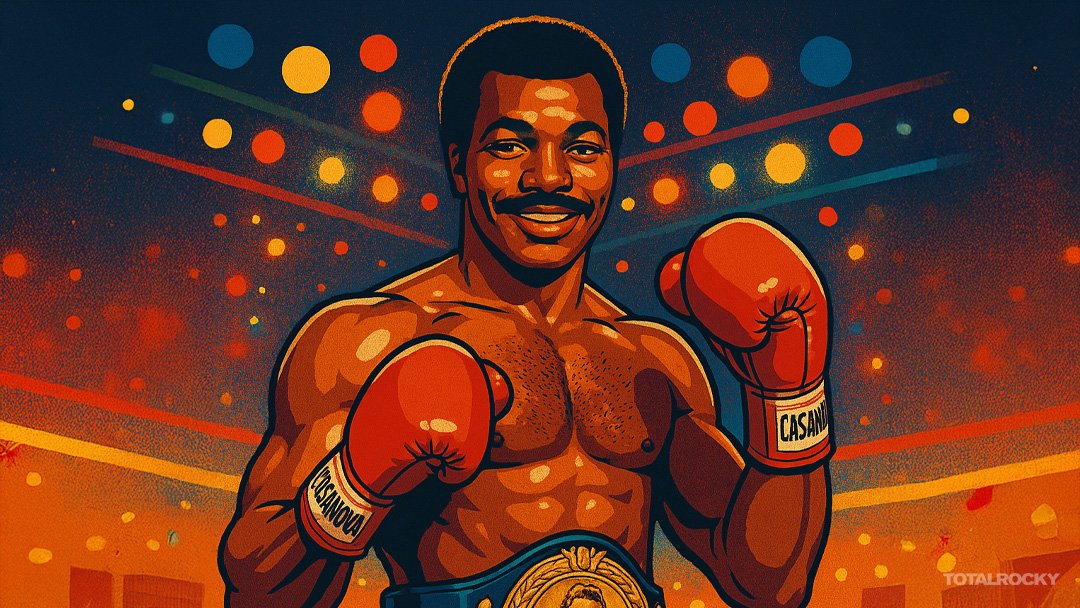
Apollo Creed stands as one of cinema’s most compelling characters—a charismatic and complex figure whose journey from heavyweight champion to mentor and friend has left an indelible mark on the Rocky franchise. This comprehensive biography delves into the creation, portrayal, and narrative arc of Apollo Creed, offering an in-depth exploration for dedicated fans.
The Genesis of Apollo Creed
In the mid-1970s, Sylvester Stallone, an aspiring actor and screenwriter, envisioned a story that encapsulated the underdog spirit. While crafting the narrative of Rocky, Stallone sought to create a formidable opponent for his protagonist—a character who embodied success, showmanship, and the pinnacle of boxing prowess. This vision materialized in the form of Apollo Creed, a character inspired by real-life boxing legend Muhammad Ali.
Ali’s flamboyant personality, poetic trash-talk, and strategic brilliance in the ring served as the blueprint for Creed’s character. Stallone aimed to depict Creed not merely as an antagonist but as a multidimensional figure whose confidence and charisma would challenge Rocky Balboa both physically and mentally.
Casting Carl Weathers: Bringing Creed to Life
The search for an actor to embody Apollo Creed led to Carl Weathers, a former professional football player turned actor.
Weathers’ athletic background and commanding presence made him a natural fit for the role. His audition, however, was marked by a candid remark that would solidify his place in cinematic history. Unaware that Stallone was both the writer and the intended lead actor, Weathers, after reading lines with Stallone, commented, “I could do a lot better if you got me a real actor to work with.” This unintentional slight resonated with Stallone, who saw in Weathers the same brash confidence that defined Apollo Creed.
Reflecting on the incident, Weathers later noted, “Sometimes the mistakes are the ones that get you the gig.”
Apollo Creed’s Character Profile
Physical Attributes:
- Height: Approximately 6’2″
- Weight: 221 lbs during his fight with Ivan Drago
- Appearance: Athletically built with a smooth, muscular physique and a light coffee-colored complexion.
Personality Traits:
- Charismatic Showman: Creed relished the spotlight, often engaging in elaborate pre-fight theatrics and promotional events.
- Strategic Thinker: Beyond his physical abilities, Creed was a savvy businessman, understanding the entertainment aspect of boxing.
- Prideful and Confident: His unwavering self-belief sometimes bordered on arrogance, influencing his decisions both in and out of the ring.
The Rise of a Champion
Apollo Creed’s ascent in the boxing world was nothing short of meteoric. By 1975, at just 28 years old, he held the title of undisputed heavyweight champion of the world. His record was staggering—dozens of wins, almost all by knockout, and not a single blemish in the loss column. More than just a technician in the ring, Creed was a strategist. He knew how to study an opponent, how to sell a fight, and most importantly, how to win.
But his success wasn’t just built on physical dominance. Creed understood that boxing was as much about the spectacle as it was the sport. Every one of his fights was an event—complete with custom-made trunks, choreographed entrances, patriotic themes, and national media coverage. He turned the squared circle into his personal stage. Whether he was sparring in Las Vegas or promoting fights coast to coast, Apollo made sure every eye in the house was locked on him.
His entourage, led by his lifelong trainer and confidant Tony “Duke” Evers, was essential to the show. These weren’t just cornermen—they were producers of a boxing empire. They choreographed the timing, the promos, the press conferences, and the pacing of every match. To the public, Apollo was a superhuman gladiator. But to those behind the curtain, he was a businessman, a perfectionist, and a master of his craft.
The Bicentennial Bout: Creed vs. Balboa
In 1975, as the United States approached its bicentennial celebration, Creed sought to stage a memorable title defense.
Originally scheduled to fight Mac Lee Green on January 1, 1976, plans changed when Green withdrew due to a hand injury. Seizing the opportunity for a unique promotional angle, Creed decided to offer a shot at the title to a local underdog, embodying the American dream. This decision led to the selection of Rocky Balboa, a relatively unknown fighter from Philadelphia. Creed’s choice was driven by his flair for entertainment and belief that the match would be an easy victory, providing a patriotic showcase.
The fight, however, defied expectations. Balboa’s resilience and determination pushed Creed to his limits, resulting in a grueling 15-round battle. Though Creed won by split decision, the match left him contemplating his own vulnerabilities. This unexpected challenge bruised Creed’s ego and led to a highly publicized rematch. Determined to prove his superiority, Creed trained intensely, ultimately losing to Balboa by knockout in the 15th round. This defeat marked the end of his reign as champion and prompted his retirement from professional boxing.
Eye of the Tiger: Creed Returns to the Ring—As a Coach
By the time Rocky III rolls around, Apollo Creed has stepped away from fighting—but his pulse still beats to the rhythm of the ring. Though no longer champion, Apollo remains larger than life: tailored suits, custom Rolls, and that unmistakable confidence. He sees something troubling in Rocky Balboa after the champ suffers a devastating loss to Clubber Lang—something familiar.
Rocky’s trainer Mickey has died. His title is gone. And worse—his spirit is broken.
That’s when Creed steps forward.
“Let Me Train You”: A New Kind of Fight
Apollo offers something Rocky never expected: mentorship. Not just help with the fight—but a rebirth.
“Let’s do it the old way,” Creed tells him.
They ditch Philadelphia for the sweat-soaked gyms of Los Angeles, where Apollo first sharpened his craft. They step into Tough Gym—Creed’s original proving ground. The place is raw, gritty, and real. Just like the fighters it molds.
Creed strips Rocky down and begins to rebuild him—not with brute force, but with rhythm, speed, and smarts.
Building a New Rocky
Gone are the heavy punches and predictable footwork. In their place: agility drills, jump rope, head movement, and foot speed. Apollo wants Rocky to float like a feather and strike like a blade. The goal? Outdance and outthink Clubber Lang.
“You gotta get that look back, Rock,” Creed tells him. “Eye of the tiger, man.”
Apollo pushes hard. Early-morning beach sprints. Grueling sparring. Music blaring from old tape decks. Every rep, every lap, every drop of sweat is designed to reignite Rocky’s inner predator.
And one day—Rocky finally beats Apollo in a beach sprint. That’s the moment it all clicks. The fire is back.
Victory—For Both of Them
Rocky goes into the rematch with Clubber Lang a completely transformed fighter. He’s faster. More tactical. He doesn’t just survive—he dominates.
Three rounds. Knockout. Title regained.
But this win isn’t just Rocky’s. As Apollo leans into the ropes from his corner, grinning wide, you can see the pride in his face. He didn’t just coach a champ. He resurrected one.
Apollo never fought professionally again. But by passing on his knowledge, his discipline, and that legendary hunger—he stayed right where he belonged – in the heart of the ring.
Apollo Creed’s Final Round
By 1985, Apollo Creed had been out of the ring for several years, retired from professional boxing and enjoying a second life as a charismatic TV commentator. He still drove a Rolls-Royce. He still wore the finest suits. But he wasn’t content. He was restless. The roar of the crowd, the energy of the arena—he missed it. Deep down, Apollo Creed wasn’t just a fighter. He was a performer. And the spotlight, once his second home, was starting to drift toward the next generation.
So when a press tour announced that an undefeated Soviet boxer named Ivan Drago was coming to America, Creed saw opportunity—not for a comeback, but for a statement. Drago wasn’t just a fighter. He was a political symbol. Cold. Silent. Ruthlessly mechanical. Creed, a proud American showman, felt a fire re-ignite.
“This is not just an exhibition fight. This is us against them.”
Despite warnings from his longtime trainer and surrogate father figure Tony “Duke” Evers, and concern from his wife Mary Anne, Apollo pushed forward. Duke knew something was off. He said as much: “This is not the way to do it. You don’t know what you’re up against.” But Apollo brushed it off. “You think I’m just going to crawl back in a hole somewhere?” he snapped.
Rocky agreed to train with him in Las Vegas. They ran through the Strip at 4:00 a.m., dodging taxis and tourists. Apollo was all flash and fury—jumping rope to music on a boombox, throwing lightning-fast jabs in sparring sessions, and grinning for the cameras like he hadn’t aged a day.
But something was wrong. As Duke noted during camp: “He’s showboating. He’s not training to survive.” Rocky quietly worried that Apollo needed another week or two. “No way,” Apollo told him. “I’m ready now.”
“I want you to promise me you’re not gonna stop this fight, no matter what.”
On fight night, Creed entered the ring dressed like George Washington, dancing to James Brown’s “Living in America,” flanked by red, white, and blue. The crowd was electric. It was vintage Creed—an American spectacle.
But what started as a show quickly turned dark.
Drago stood motionless during the fanfare. No grin. No nerves. Just steel. And when the bell rang, it became clear that Apollo had made a fatal miscalculation. The Russian was a 261-pound juggernaut, throwing punches like missiles. Creed was lighter at 221 pounds, built on speed and finesse—but none of that mattered when every blow from Drago rattled the ring.
“He’s killing him!” Duke screamed.
In between rounds, Rocky saw the writing on the wall. “Let me throw the towel,” he begged.
“No,” Apollo insisted. “I’m not going out like that.”
Mary Anne shouted from ringside. Duke pleaded. But Apollo refused to quit.
Then came the final blow.
Drago launched an uppercut that snapped Creed’s head back and sent him crashing to the canvas. The sound of his skull hitting the mat was described in the novelization as “the sound of a watermelon dropped from a great height.” His occipital lobe was crushed. Blood flooded his brain cavity. And yet, his body twitched.
Rocky stood there, towel in hand—too late.
The referee called for the medics. The MGM Grand was silent. The man who once lit up arenas across the world lay broken beneath the lights.
As Creed slipped away in Rocky’s arms, Drago turned to the crowd and coldly muttered: “If he dies, he dies.”
The Aftermath
Apollo Creed’s death was more than a loss for the boxing world—it was the end of an era. The funeral was held with dignity. His casket, black with brass handles, rested under a closed lid. Mary Anne sat in silence. She would later tell her son Adonis, “Your father died before he had a chance to know you.”
For Rocky, Apollo’s death was personal. The guilt of not throwing the towel haunted him. It drove him to accept a fight in Moscow, where he would face Drago on Soviet soil with no entourage, no crowd, and no promises.
Apollo Creed didn’t die for glory. He died for pride—for the show, for the principle, and for a piece of his youth.
Personal Life and Legacy
Outside the ring, Apollo Creed led a life filled with both triumph and complexity. He was married to Mary Anne Creed, a composed and private woman who provided a grounding contrast to Apollo’s larger-than-life personality. Their marriage endured through fame, fights, and personal struggles, lasting at least 17 years by the time of Rocky IV. While Apollo thrived on public attention, Mary Anne preferred to remain in the background—an arrangement that worked for them. As the novelization of Rocky notes, “She required privacy and he basked in publicity, but it was a successful relationship.”
However, Apollo’s appetite for attention and thrill didn’t stop at the ropes. During his final training camp in Las Vegas before the exhibition match with Ivan Drago, he had a short-lived affair with a woman named Johnson. From that fling, a son was born—Adonis. Apollo died without knowing about the child. Johnson raised Adonis alone until her untimely death, after which Mary Anne found the boy in a group home and took him in.
Adonis Creed would grow up to follow his father’s path, carving his name into the boxing world in his own right. The father-son connection, though posthumous, becomes the emotional core of the Creed spin-off films.
Adonis later has a daughter of his own, Amara Creed, making Apollo a grandfather. Though Apollo never lived to meet her, his legacy continues through Amara—a new generation raised in the shadow of greatness.
From world champion to icon to patriarch, Apollo Creed’s story doesn’t end with his final bell. His bloodline continues to fight, to rise, and to represent everything he once stood for: pride, power, and the will to go the distance.