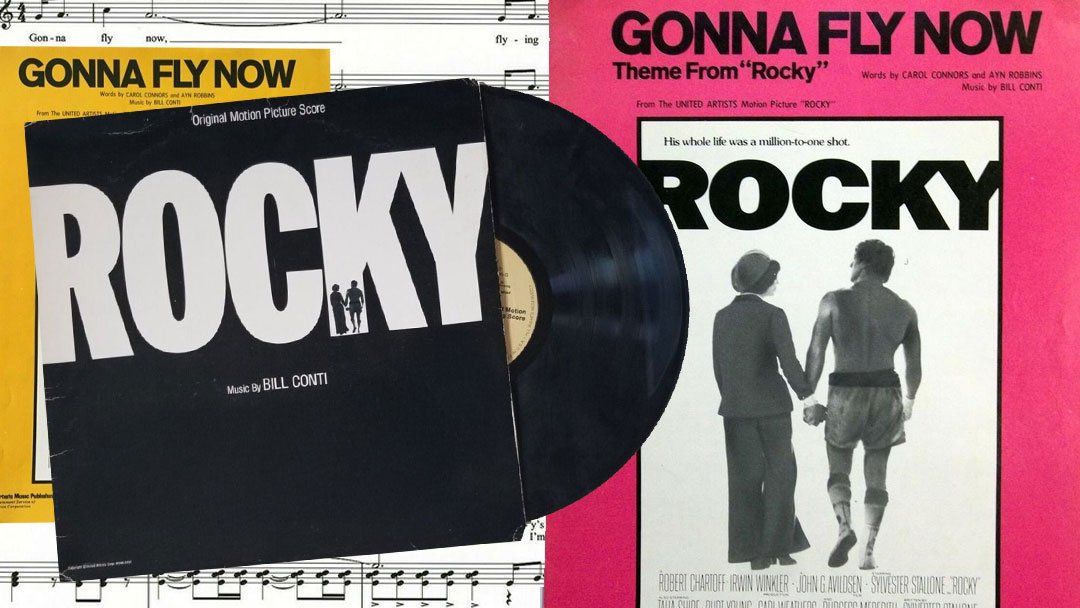
The Rocky theme song, better known as “Gonna Fly Now,” is more than a movie anthem—it’s the ultimate soundtrack for beating the odds.
Composed by Bill Conti, with punchy lyrics by Carol Connors and Ayn Robbins, this power-packed tune first hit audiences in Rocky (1976), playing behind the iconic training montage that ends with Rocky pounding up the Philadelphia Museum of Art steps. With its soaring trumpets, funk groove, and only 30 words of lyrics, the “Gonna Fly Now” song punches way above its weight class.
This deep-dive explores how the Rocky theme song came to be, how Conti made it on a shoestring budget, and how the track became one of the most recognizable pieces of film music in history.
Bill Conti: The Man Behind the Music
In 1976, Bill Conti wasn’t a household name. He was a 34-year-old composer with a few European and indie credits to his name—talented, classically trained, but still flying under the radar. However, he had previously worked with John G. Avildsen on a smaller project, and when the director needed someone both affordable and reliable for Rocky, he knew who to call.
Originally, the studio had someone else in mind: David Shire, an established composer known for his moody, sophisticated scores in The Conversation and The Taking of Pelham One Two Three. He was also, at the time, married to actress Talia Shire, who played Adrian in the film. However, Shire turned it down—reportedly due to the project’s razor-thin music budget.
That decision opened the door for Conti.
The producers didn’t sugarcoat the offer. They told him flatly: “Here’s a million-dollar movie, and $25,000 to score the whole thing—take it or leave it.” Conti took it—and then some. He didn’t just write the score. He threw himself headfirst into the project. Conti composed, orchestrated, conducted, and even played piano on the recordings.
Yet his strength wasn’t just technical ability—it was storytelling. Conti had a sharp instinct for emotion and knew how to translate character arcs into melody. With the Rocky soundtrack, he took a humble, downbeat theme and charged it up into something triumphant—something that makes the audience believe the underdog might actually win.
And it worked. “Gonna Fly Now” didn’t just lift Rocky—it launched Conti. After Rocky, he became one of Hollywood’s go-to composers, scoring hits like The Right Stuff (which earned him an Oscar), the Karate Kid series, and multiple James Bond films including For Your Eyes Only.
Still, despite all the accolades, Conti often said the Rocky theme song meant the most to him. It wasn’t just a job—it was music that moved people. And that’s exactly what he set out to do.
From Loser’s Lament to Anthem: Composing “Gonna Fly Now”
Before it became the brass-blasting, chest-thumping anthem we know today, the Rocky theme song started in a very different place.
When Bill Conti first read Sylvester Stallone’s screenplay, he didn’t see a Hollywood superhero. He saw a beaten-down man trying to prove he was more than just another face in the crowd. “Here is a movie that is about a loser. I read the script, I know how it ends—he loses,” Conti later recalled. That initial emotion shaped his first version of the score: a slow, melancholy theme that echoed Rocky’s humble, overlooked status.
But everything changed in the tenth reel.
That’s when Conti got to the training montage—the moment when Rocky starts to believe in himself. The music had to lift the audience right alongside him. “He gets to train for a big fight, and we want to manipulate the audience to think that he can win,” Conti explained. So he flipped the music’s tone. Out went the brooding strings. In came a soaring fanfare, a driving rhythm, and a newfound pulse of energy. “Let’s make it peppy and fast and give him some inspiration.”
To seal that emotional shift, Conti decided to add lyrics.
He teamed up with lyricists Carol Connors and Ayn Robbins to craft something simple, repeatable, and powerful. The trio didn’t want to weigh the song down with exposition or fluff. Instead, they focused on a minimalist mantra—a 30-word chant that felt like Rocky’s own thoughts breaking through the soundtrack.
According to Connors, the song’s anchor—“Gonna fly now”—came to her in the shower. It hit her as the perfect phrase to capture Rocky’s transformation. He’s not there yet… but he’s ready to rise.
Lyrics to “Gonna Fly Now”
Trying hard now
It’s so hard now
Trying hard now
Getting strong now
Won’t be long now
Getting strong now
Gonna fly now
Flying high now
Gonna fly… now
Minimal words. Maximum impact.
The structure of the song mirrors Rocky’s own emotional arc: struggle, strength, and finally… flight.
Recording “Gonna Fly Now”: Inside the Studio Session
The recording of “Gonna Fly Now” was fast, focused, and fiercely efficient. Bill Conti had one three-hour window at United Artists Studio in Hollywood to get it done. Working under tight union hours and an even tighter budget, he assembled a handpicked team of elite session players, vocalists, and engineers to bring the score to life.
At the helm of the soundboard was Ami Hadani, veteran engineer and co-founder of TTG Studios. Known for balancing orchestral tones with modern pop production, Hadani was the perfect choice to wrangle Conti’s hybrid of classical fanfare and street-level funk. His mix gave every element its own space—from the piercing trumpets to the soulful vocals—and helped make the song radio-ready.
Conti conducted the orchestra himself, and even added his own piano to the final recording. He also worked closely with editor Richard Halsey to match the music to the film’s visual rhythm, ensuring moments like the final “Gonna fly now!” lyric landed precisely as Rocky reached the top of the steps.
That tight synchronization between image and score? No accident. It was composed to fit the edit, beat-for-beat.
Building the Sound of the Rocky Theme: Brass, Grit, and Three Voices
Though the orchestration sounds massive, the “Gonna Fly Now” recording was achieved with a modest ensemble of world-class musicians.
The rhythm section brought the groove:
- John Guerin on drums (a jazz fusion powerhouse)
- Max Bennett on bass (known for his work with Frank Zappa)
- Dennis Budimir on guitar (providing that subtle wah-wah Philly-soul texture)
- Mike Melvoin on keyboards (laying down harmonic structure)
These players locked in tight to create the track’s driving pulse—funky enough to move, bold enough to inspire.
On the orchestral side, Conti conducted the Hollywood Studio Symphony, featuring brass legends:
- Malcolm McNab and Uan Rasey on trumpet—responsible for the high-flying brass fanfare
- Tony Terran, Vincent DeRosa, Dick Nash, and Tommy Johnson filling out the horn and low brass sections
Conti’s orchestrations squeezed the most from the ensemble. His trumpet lines soared. The strings surged. Every part was designed to sound bigger than the budget should’ve allowed.
Making Three Voices Sound Like Thirty: The Vocal Illusion
If you’ve ever thought the Rocky theme had a full choir behind it—you’re not alone. But that massive choral sound? It was just three singers, expertly layered.
- DeEtta Little West: the powerhouse soprano who delivered the iconic “Getting strong now!” line with soulful lift.
- Nelson Pigford: a bass-baritone with deep R&B roots, adding richness and grounding harmonies.
- Shelby Conti: Bill’s wife, uncredited, but essential—she completed the harmony stack that gave the track its choral fullness.
Carol Connors and Ayn Robbins, the lyricists, crafted the perfect vocal phrases—minimal, repeatable, and emotionally potent. And with Conti behind the glass, the trio double-tracked and overdubbed their parts until they sounded like an army.
“Strong, powerful voices can be overdubbed once and it sounds like an amazing choir,” DeEtta explained to Total Rocky. The trick saved money and delivered chills.
Few takes were needed. Conti knew what he wanted. The singers nailed it. And the final mix—under Hadani’s expert hands—blended it all into one of the most recognizable vocal themes in film history.
The Training Montage That Cemented the Song’s Legacy
The Rocky training montage isn’t just iconic—it’s surgical in its synchronization. It’s where “Gonna Fly Now” does its heaviest lifting, turning a series of workout shots into a full-blown cinematic crescendo.
In the 1976 film, the sequence shows Rocky transforming from a slow, exhausted club fighter into a determined contender. It opens in early dawn with Rocky jogging sluggishly through the streets of Philadelphia—no dialogue, no crowd, just persistence. At this point, the music is minimal: steady rhythm, light instrumentation. Then, as Rocky’s training intensifies—one-arm pushups, heavy bag drills, sprinting past cargo ships—the music rises in parallel. New layers come in: bold brass, faster tempo, swelling strings.
Editing That Syncs Emotion and Sound
Every visual beat lands on a musical cue. As Rocky runs past hulking ships at the harbor, the lyric “getting strong now” hits. As his confidence builds, the orchestration thickens—fanfare trumpets, aggressive percussion, and ultimately, vocals that feel like a stadium chanting him forward.

Editor Richard Halsey cut the entire montage to match Bill Conti’s musical rhythm. It wasn’t the usual film-scoring method of fitting music under locked footage. Instead, the footage was shaped to the music. Conti composed with emotional cues in mind, and Halsey edited to hit those peaks and valleys precisely. When Rocky dashes up the 72 stone steps of the Philadelphia Museum of Art, the trumpets begin to soar in ascending lines. As he crests the summit, throws his arms up in victory, the final lyric “Gonna fly now!” hits right on cue.
It’s not coincidence—it’s craftsmanship.
A Blueprint for Every Underdog Montage That Followed
Conti wrote the piece specifically to fit the pacing and timing of the montage. He coordinated closely with Halsey to ensure that musical peaks matched visual ones. One of the most striking examples is when Rocky reaches the top of the steps: the music reaches its loudest, boldest moment, the vocalists hit the final lyric, and the camera circles to face Rocky in slow motion. It’s a beat-for-beat fusion of picture and score that remains one of the most mimicked sequences in sports cinema.
Before that moment, a different cue titled “Philadelphia Morning” underscores Rocky’s 4:00 AM jog. It’s quiet and lonely. That contrast makes “Gonna Fly Now” hit even harder—musically representing Rocky’s growth from struggling everyman to self-made warrior.
The montage compresses weeks of training into two-and-a-half minutes, turning his entire transformation into a visual and auditory sprint. The choice to use a music-only sequence with no dialogue was considered bold at the time. It let the music carry the entire emotional arc. There’s no narration, no explanation. Just sweat, movement, and sound.
The approach worked so well it became a blueprint. Future sports films—and later Rocky sequels—would copy this structure: a training montage set to a pulse-pounding song. But nothing quite matches the precision and emotion of this original.
Film schools now study this scene. Editors dissect it. And every fan who’s ever jogged up those steps—real or imaginary—feels that surge when they hear those opening trumpets.
Chart Domination and Award Recognition
When “Gonna Fly Now” was released as a single in early 1977, it wasn’t just a movie theme—it became a cultural juggernaut.
United Artists Records issued the single shortly after Rocky hit theaters, crediting it to Bill Conti and his Orchestra, with vocals by DeEtta Little and Nelson Pigford. The song’s fusion of orchestral fanfare, soul-infused rhythm, and punchy vocals made it instantly recognizable. It rocketed up the Billboard Hot 100, reaching #1 on the chart for the week of July 2, 1977, displacing disco and rock giants of the day. It stayed in the Top 40 for multiple months, and Billboard ranked it the #21 song of the entire year—an astonishing feat for an instrumental-based track tied to a film score.
The single went on to sell over a million copies, earning a Gold certification from the RIAA. Conti’s version even had chart competition from jazz trumpeter Maynard Ferguson, whose cover of “Gonna Fly Now” charted separately, helping spread the theme’s reach into sports arenas and radio playlists across the country.
Critical Recognition and Industry Honors
Despite being a soundtrack piece, the song garnered serious recognition from the music industry:
- At the 49th Academy Awards in 1977, “Gonna Fly Now” was nominated for Best Original Song, with credit going to Bill Conti (music) and Carol Connors & Ayn Robbins (lyrics). It lost to “Evergreen” from A Star Is Born, but the nomination alone signaled its creative power.
- At the 1978 Grammy Awards, it earned two major nominations:
- Best Instrumental Composition (Conti, Connors, Robbins)
- Best Pop Instrumental Performance (Conti as the artist)
While both Grammys ultimately went to John Williams for his Star Wars score, the dual nods elevated “Gonna Fly Now” beyond a soundtrack novelty. It was now viewed as a musically sophisticated piece with real compositional depth.
Public Reaction and Legacy
Public reception was overwhelmingly positive. In 1977, “Gonna Fly Now” was inescapable—it was blasted in locker rooms, high school gyms, jukeboxes, and even TV variety shows. The track didn’t just accompany workouts—it became one.
The song’s mass appeal had a lot to do with its mix of classic and modern styles. With disco-era funk in the rhythm section and old-school Hollywood brass at the front, it walked a tightrope between pop song and heroic overture. Some critics called it over-the-top; New York Times critic John Rockwell famously dubbed it “a classic bit of movie-music pomposity” with “cheesy inspirational appeal”. But even that semi-snarky review admitted its effectiveness.
Audiences didn’t care about subtlety—they embraced it. The bold, feel-good bombast was exactly what the movie called for.
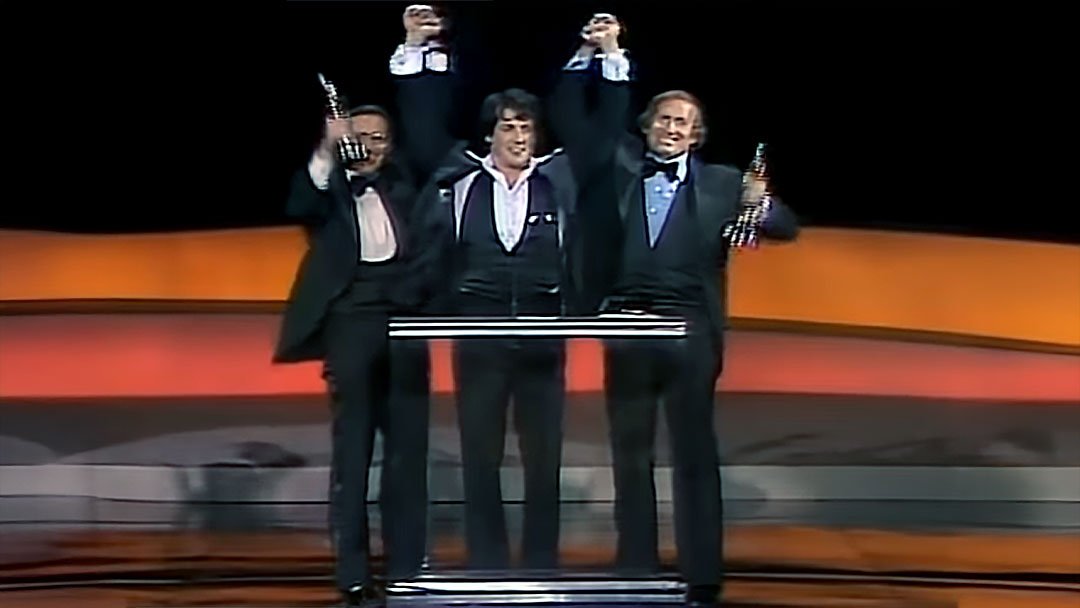
Conti’s newfound fame led to him being invited to conduct the Oscars orchestra the following year, kicking off a decades-long tenure at the Academy Awards podium. His name became inseparable from Rocky, and “Gonna Fly Now” became one of the most played and imitated movie themes in pop culture history.
The Lasting Legacy of “Gonna Fly Now”
“Gonna Fly Now” didn’t just complement Rocky—it helped define it. What began as a low-budget film cue became one of the most recognizable and emotionally charged pieces of music in pop culture.
The song continues to thrive: played in stadiums, remixed by DJs, quoted in film schools. The Rocky Steps remain a pilgrimage site, where fans from around the world reenact that iconic scene—often with the theme playing in their earbuds or echoing in their heads. The Philadelphia Eagles still blast it before home games. Marching bands, marathons, political rallies, and movie parodies keep it in constant rotation.
In 2004, the American Film Institute ranked it among the 100 greatest movie songs of all time—one of the few instrumentals on the list. Even critics who once dismissed it as bombastic have come around, recognizing its enduring appeal. As Bill Conti once said, “The music seemed to affect people… I know from reactions in letters that it helped people emotionally.”
The influence carries into today’s films. Composer Ludwig Göransson, who scored the first two films of the Creed series, has cited Conti’s work as an inspiration. In particular, his track “Getting Stronger” from Creed II nods to Gonna Fly Now—both musically and emotionally—echoing its spirit of rising determination and resilience.
In doing so, Göransson shows that even decades later, the DNA of Conti’s original Rocky theme still powers new generations of underdog stories.
And ultimately, as long as there are people willing to fight for something—“Gonna Fly Now” will be playing somewhere in the background.