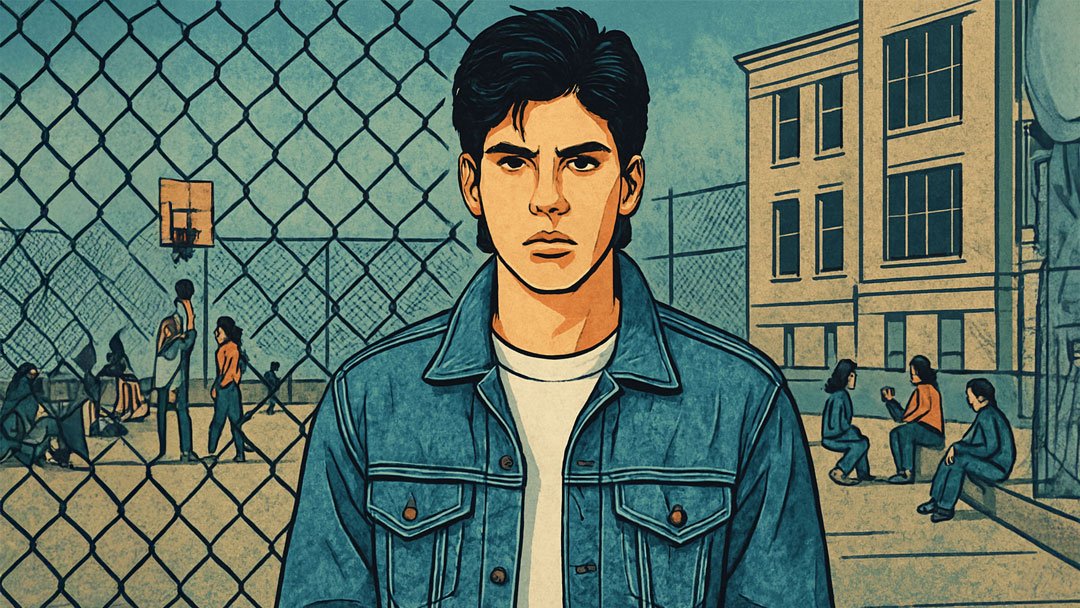
Across the Rocky franchise, Robert Balboa Jr — the only child of Rocky and Adrian — has been portrayed by a rotating lineup of actors. Each brought a different energy to the role, shaped by the era and the film’s emotional tone. Here’s the real-world history behind the faces of Rocky’s son.
Rocky II (1979) – Twin Baby Boys
Let’s clear up an urban myth: the infant in Rocky II was not Seargeoh Stallone, despite rumors claiming Sly’s son made his screen debut here. In reality, the role was filled by twin boys, who were filmed over a two-day period in 1978 to legally satisfy child labor limits.
A deleted scene from Rocky II shows Rocky and Adrian shopping together for nursery furniture — picking out a crib and setting up a space for their baby. In a separate moment from the final film, Rocky tells Adrian that with his fight winnings, he’s going to buy a Kermit the Frog toy for their new baby. He refuses to meet his son until Adrian wakes from her coma, so they can see him together — one of the most emotional moments in the entire series.
Rocky III (1982) – Ian Fried
In Rocky III, Robert is now a little kid, seen wearing glasses like his mother Adrian. He was portrayed by Ian Fried, born December 17, 1974, in Akron, Ohio. Fried also lent his voice to The Secret of NIMH (1982) and appeared in Movie Madness (1982).
After working in Hollywood during the early 1980s, Ian pursued a career in journalism. Known today as Ina Fried, Fried became a respected technology writer covering Microsoft and mobile tech for outlets like CNET and All Things Digital.
Rocky IV (1985) – Rocky Krakoff
In Rocky IV, Robert shows up looking a bit different — the dark-haired Italian kid from the previous film now has sandy brown hair and a new group of friends. He’s into gadgets, hangs out with Uncle Paulie’s robot, and serves more as comic relief than a central emotional thread. Robert was played by Rocky Krakoff, who appeared in several well-known films during the 1980s.
Krakoff’s acting credits include Testament (1983), Poltergeist II: The Other Side (1986), Arachnophobia (1990), Ghost Dad (1990), and Disney’s Oliver & Company (1988). He also appeared in When the Bough Breaks, Short Time, and Welcome Home Roxy Carmichael (1990) alongside Winona Ryder. After a busy stretch in film and TV, Krakoff stepped away from the acting world in the early ’90s.
Rocky V (1990) – Sage Stallone
In Rocky V (1990), the emotional core of the story shifts hard into fatherhood. Sylvester Stallone cast his real-life son, Sage Stallone, as Robert Balboa Jr., and in our opinion, it’s the most grounded and authentic portrayal of the character. You can’t fake what’s on screen — the tension, the affection, the rawness — that’s real-life chemistry between father and son.
Sage, 14 at the time, played Robert as a smart, sharp kid whose world is suddenly turned upside down. The Balboa family loses everything and moves back to South Philly. Robert goes from honor student to inner-city underdog, facing bullies and struggling to fit in. Despite his parents urging him to use his mind over his fists, he starts training at Mighty Mick’s Gym with Paulie in his corner. One of the film’s most emotional scenes comes when Rocky gives him the Rocky Marciano glove necklace, a symbol of legacy and love.
Stallone explained in a talk show appearance that Sage had to earn the role:
“He had to audition for the part because I didn’t want the responsibility of having this on my conscience if he didn’t deliver… and he came out on top. This was not my choice — it was the studio’s.”
Later in the same interview, Stallone said Sage was perfect for the role because he had never lived through the kind of struggle the character was facing:
“He has no idea what it’s like to be on the other side… he was born into it. That’s why he was perfect for the part.”
Sage did not reprise the role in Rocky Balboa (2006), as he was directing his own film, Vic. He later became known for his work as a film historian and preservationist. His death in 2012 at age 36 cut short a promising creative life. But his performance in Rocky V remains unforgettable — raw, real, and full of heart.
Rocky Balboa (2006) and Creed II (2018) – Milo Ventimiglia
In Rocky Balboa, the role of Robert Balboa Jr. was portrayed by Milo Ventimiglia, known for his work on “Heroes” and “This Is Us.” At 29, Robert is a clean-cut accountant working at a securities firm in Philadelphia, grappling with the challenges of living in the shadow of his father’s legendary boxing career.
Ventimiglia’s casting was influenced by his physical resemblance to Sylvester Stallone – their matching facial paralysis. Both actors have a slight facial paralysis affecting their lips, which Stallone felt added authenticity to their on-screen father-son relationship. This similarity contributed to Stallone’s decision to cast Ventimiglia in the role.
Milo’s portrayal was well-received, leading to his return in Creed II, making him the only actor to play Robert Balboa Jr. in more than one film. His performance effectively captured the nuanced dynamics of a son striving to establish his own identity while dealing with the complexities of his father’s fame.
The Life of Robert Balboa Jr in the Rocky Universe
Robert Balboa Jr. was born in Philadelphia in the fall of 1976, just weeks before his father’s rematch with Apollo Creed. He came into the world one month premature, delivered under emergency conditions after Adrian collapsed and slipped into a coma. Rocky wouldn’t see his son until Adrian regained consciousness — insisting they meet him together as a family.
Once Adrian recovered, they decided to name the baby Robert, after his father. Paulie had pitched the idea of “Paulie Jr.,” but it didn’t stick. In the Rocky II novelization, it’s Rocky himself who jokes about the name “Rocky Junior,” saying that Rocky was always the kind of name given to dogs, horses, or things that got hit a lot — and that they were tough enough for it. That name — equal parts grit and sentiment — stayed. And with it, Robert Balboa Jr. became more than just Rocky’s son. He became a symbol of the life Rocky and Adrian fought to build together.
Childhood and Adolescence
In Rocky III, Robert is growing up in the public eye. He’s shy, soft-spoken, and spends a lot of time with Uncle Paulie. Like his mother, he wears glasses, and there’s a quiet sensitivity about him that sets him apart from the noise of the media circus surrounding his dad. He clearly looks up to Rocky — watching his training, attending fights, and soaking in the energy of his father’s world, even if he’s not quite old enough to fully understand it.
By the time Rocky IV rolls around, Robert’s character takes on a broader, more mainstream kid persona. He’s got friends over at the house, he’s into gadgets, and he gets a kick out of Paulie’s robot. The quiet, glasses-wearing boy from the last film is now a more socially adjusted kid who enjoys spending time with his dad and hanging around the house while Rocky trains in Russia.
But even amid the toys and tech, the Rocky IV novelization reveals a deeper undercurrent. Adrian watches Robert closely and sees the change. He’s growing up fast — pulling away from her emotionally, no longer her little boy. He doesn’t know exactly what he is yet, but he knows he’s not that anymore. It’s a subtle but poignant moment that shows the tension between childhood innocence and the early stirrings of identity — even for a kid growing up in a boxing dynasty.
Rocky V: The Emotional Peak
By the time we get to Rocky V, Robert is in his early teens and on the edge of becoming his own man. He’s bright, articulate, and clearly more book-smart than street-smart. He’s doing well in school — even on the honor roll — and he’s starting to develop his own interests, including girls and drawing. There’s a quiet, preppy side to him now, hinting that he may be more Adrian’s son than Rocky’s in some ways. He’s clean-cut, thoughtful, and carries himself like a kid raised in comfort.
But everything changes when the Balboas lose their fortune. A crooked accountant and a bad signature send them crashing back to South Philadelphia. The mansion’s gone. The lifestyle? Gone. Robert’s thrown into public school in a working-class neighborhood — a world he’s totally unprepared for.
On his first day, two kids jump him and steal his designer leather jacket. It’s a hard wake-up call. He starts to feel abandoned, as Rocky becomes distracted by managing rising boxing star Tommy Gunn. Despite his parents urging him to solve problems with his head, not his fists, Robert starts training at Mighty Mick’s Gym — the same gym Mickey had willed to him after his death.
It’s the most screen time the character has ever had, and the film explores his identity in a way no other entry does. He’s not trying to be his father — he’s trying to figure out who he is when everything around him changes. Through training, he starts to rebuild confidence. He even lands his first girlfriend, Jewel, a local girl who sees something in him beyond the name.
This chapter of Robert’s story is about resilience — not in the ring, but in the real world. It’s about a kid caught between privilege and pressure, trying to carve out a space of his own.
Rocky Balboa: Growing Apart, Coming Back Together
In Rocky Balboa (2006), Robert is in his late twenties and living a clean, successful life on the surface. He works as an accountant at a securities firm in Center City Philadelphia, wears suits, and carries himself like a man who’s carved out a future using his head, not his fists. It’s clear he takes after Adrian — intelligent, polished, and emotionally guarded.
But underneath the sharp wardrobe and respectable job title, there’s tension. The weight of his dad’s name still looms large. Robert has spent most of his adult life trying to build his own identity — one separate from “Rocky’s kid.” When ESPN airs a computer simulation of a fight between his father in his prime and current heavyweight champ Mason “The Line” Dixon, Robert is visibly uncomfortable. He doesn’t want the spotlight — especially not on someone else’s terms.
When Rocky announces his return to the ring for a sanctioned exhibition match, Robert pulls away. He admits he’s tired of living in his father’s shadow. The way he says it isn’t bitter — just tired. He still loves his dad, but he’s not a kid anymore. He’s a grown man who’s spent years trying to escape the pressure of being “Baby Rocky”.
Over time, Robert faces those feelings head-on. He says he’s afraid of what the fight means — for Rocky, and for himself. He wants to be seen as his own man, not just an extension of his father. Eventually, he quits his job and joins Rocky in Las Vegas — not because he has to, but because he chooses to.
He’s not just in his father’s corner — he’s there when it matters. After the fight, Robert walks out with Rocky and the team. No big speeches, no dramatic moment. But ultimately, they’ve reconnected as a family. Adrian would like that.
From Philadelphia to Vancouver – Robert’s Role in Creed
When Creed begins, Robert is absent. Rocky explains that he moved to Vancouver, Canada, to live with his girlfriend. That’s not just a throwaway line. Vancouver is nearly 2,800 miles from Philly — a symbolic and literal distance.
In Creed, the filmmakers use a real photo of Sly and Sage Stallone when Robert is mentioned, grounding the moment in reality. The implication is clear: father and son have drifted apart again, and this time, there’s no easy fix.
Reconnecting in Creed II
But Creed II gives fans the closure they didn’t expect.
In the final scene, Rocky travels to Vancouver to meet Robert, his wife, and his grandson Logan Balboa. It’s quiet, humble, and intimate — a perfect final chapter to a relationship that has weathered decades of change.
Robert Balboa Jr. never stepped into the ring, but his life carries the heart of the Rocky series — grit, loyalty, and legacy. He was born prematurely in a Philadelphia hospital, raised in his father’s shadow, and grew into a thoughtful, intelligent man.
He built a life in finance, far from the spotlight, before eventually starting a family of his own in Vancouver. Robert’s journey doesn’t shout — it runs quietly and steadily through every chapter of the franchise.
In Rocky Balboa, during their moment of reconnection, Rocky tells his son: “You’re my family and you’re my blood.” It’s a line that cuts through years of emotional distance — simple, honest, and everything that needed to be said. By Creed II, when Rocky shows up at Robert’s home to meet his grandson, the reconnection is complete. No big speeches. Just presence, peace, and a future moving forward.
Whether he’s the quiet kid in glasses, the frustrated teen with something to prove, or the man holding his son, Robert Balboa Jr. stands as one of the most emotionally grounded characters in the series. He doesn’t fight in the ring — he fights for identity, self-respect, and family. And in the end, he finds peace.