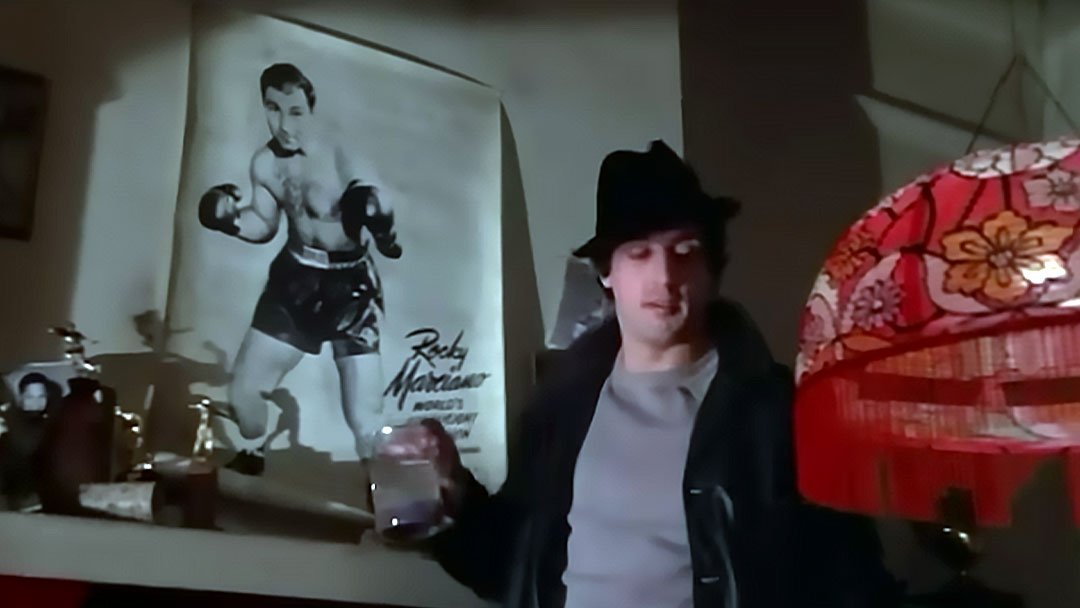
Before there was Balboa, there was Marciano.
The real-deal, Italian-American heavyweight champion who trained like a machine, hit like a truck, and stayed undefeated. Rocky Marciano’s name wasn’t just borrowed for the big screen. His fighting style, work ethic, and faith were the blueprint for Sylvester Stallone’s iconic underdog. For any hardcore Rocky movie fan or boxing purist, the connection runs deep—and it’s more than just a name.
The Poster on the Wall
In Rocky (1976), Balboa has a black-and-white 1950s poster of Rocky Marciano hanging above his mantel. At Christmas, Adrian tacks on a cotton beard to turn the Rock into Santa Claus. It’s more than a decoration—it’s a tribute (and you can get a repro of that same Marciano poster here). Mickey even stares at it and tells Rocky, “You kinda remind me of the Rock… you move like him, an’ you got heart like he did.”
Marciano wasn’t just a name Balboa admired. Growing up in 1950s Philadelphia, Rocky would have watched Marciano’s fights as a kid—probably huddled around a TV with bad reception. In many ways, Rocky Marciano was his north star.
The String Between the Feet
In one of the most memorable gym scenes in Rocky (1976), Mickey stops Balboa mid-combo and says he’s “off-balance.” He yells for Mike (Jimmy Gambina) to tie a string between Rocky’s ankles, giving about two feet of slack. Rocky says, “I ain’t never had good footwork,” and Mickey answers, “Marciano had the same problem and this string cured it.”
This wasn’t movie fantasy. Marciano’s real-life trainer Charley Goldman actually used that method. A string would be tied between Marciano’s legs during heavy bag drills. The logic? Keep your stance compact. If you step too wide, you trip or lose tension. It forces a fighter to plant correctly, keep a steady rhythm, and avoid overreaching.
Good footwork isn’t about flash—it’s about balance and economy. The string builds muscle memory for staying centered while moving. It teaches a fighter to punch in rhythm without breaking their stance. You learn to slide, pivot, and shift weight the right way. And that means every punch lands with your full body behind it.
When a guy like Marciano steps in close, keeps his feet tight, and throws combinations from perfect range—that’s when the damage piles up. You don’t lose power to missteps. You don’t waste motion. And you never leave yourself open for a counter.
It’s a brutal little trick. And it worked.
Built to Hit, Trained to Break You
Marciano wasn’t just powerful—he was a physical problem. He trained with a custom 300-pound heavy bag. Most bags are 60 to 100 pounds. His logic? If he could move that beast, he could hurt anyone. He also shadowboxed in shoulder-deep water at the YMCA until his arms gave out.
He ran five miles a day—yes, even on Christmas. During fight camp, that jumped to fifteen. His training was so brutal, his coach had to stop him from overdoing it. He didn’t just punch hard—he punched hard in round one, and again in round fifteen. Opponents like Archie Moore waited for him to gas out. He never did.
Fighting Like a Freight Train
Marciano stood 5’10” and weighed around 185 pounds. Stallone’s Balboa was 5’9” and weighed about 178 during the first Rocky. Neither had a reach advantage, but they both fought like buzzsaws. Pressure fighters. Inside brawlers. Hit-you-’til-you-drop kind of guys.
Marciano’s power came from compact punches and killer mechanics. Short arms helped him deliver energy faster—less wind-up, more velocity. According to a trauma doctor quoted by Longhhorn71, the kinetic energy from his punch was devastating. Opponents weren’t just knocked down—they were broken up inside.
Faith, Grit, and Catholic Backbone
Both Rockys—Marciano and Balboa—came from tough, Catholic, Italian families. Marciano’s faith shaped his life. He grew up praying the Rosary and going to Mass. He worked as a ditchdigger, railroad layer, and shoemaker. He only finished 10th grade. Balboa only made it to 9th. He worked in the meat packing plant and as a loan shark enforcer. Different jobs, same struggle.
In the ring and in life, both relied on faith, family, and fists.
Marciano vs. Ali: The Super Fight
In 1969, Rocky Marciano came out of retirement to film a computer-generated fantasy fight against Muhammad Ali. He lost 50 pounds and wore a toupee to match his old look. The U.S. version had Marciano win. In real life, Ali had huge respect for him. When Howard Cosell asked if he could have beaten Marciano, Ali paused. “I’m not sure,” he admitted.
That whole vibe—older warrior proving he’s still got it—gets mirrored in Rocky Balboa (2006). The movie plays like a tribute to that fight.
The Cufflink: A Symbol of Legacy
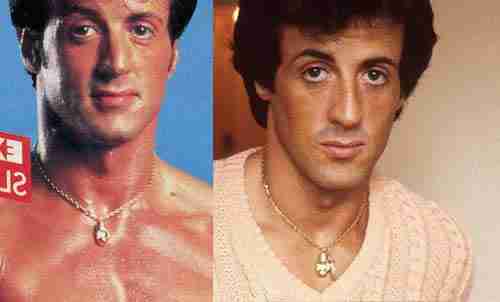
In Rocky V, a flashback reveals a powerful moment between Mickey and a young Balboa. Just before Rocky’s first fight with Apollo Creed, Mickey gives him a necklace with a tiny boxing glove. “Rocky Marciano gave me that,” Mickey says. “You know what it was? His cufflink. And now I’m givin’ it to you.”
He adds, “It’s gotta be like an angel on your shoulder. If you ever get hurt and you feel like you’re going down—this little angel is gonna whisper in your ear, ‘Get up you son of a bitch, ’cause Mickey loves you.’”
Later in the movie, Rocky passes that same necklace down to his son, Rocky Jr.—a gesture that ties three generations of fighters together.
The cufflink itself wasn’t just a prop. It was real. Joey Bishop, friend of Marciano and member of the Rat Pack, gifted the piece to Stallone. Bishop once said of the original Rocky, “Rocky Marciano would have loved this movie.”
Marciano died in a plane crash on August 31, 1969—just seven years before Rocky hit theaters in 1976. He missed it by a hair, but his presence is felt in every round Balboa fights.
For the full story on that iconic piece of jewelry, check out our boxing glove necklace breakdown.
The Real Rocky
Rocky Marciano was born on September 1, 1923, in Brockton, Massachusetts. He was the son of Italian immigrants and worked every kind of job you can think of—laying railroad, delivering ice, even making shoes—before turning pro in 1947. By the time he retired in 1956, he was the only heavyweight champion in boxing history to walk away undefeated: 49-0 with 43 knockouts.
He stood 5’10” and fought at about 185 pounds. A little shorter than most of his opponents, but that just meant he fought closer. He leaned in and broke down men who were bigger, longer, and sometimes faster. That’s part of what made him so effective—Marciano stayed in punching range and never stopped throwing.
Some of his most important wins came against legends: Jersey Joe Walcott, Ezzard Charles, Roland La Starza, and the great Joe Louis. He didn’t just beat them—he wore them out. One of his signature punches, the right hand he called the “Suzie Q,” could end a fight on contact.
He died tragically in a plane crash the day before his 46th birthday, in 1969. But his name never left the sport. For fans, he’s still the gold standard. Tough, relentless, and technically smarter than he got credit for.
And yeah — Marciano and Balboa? Same build, same hair, same skin tone. These Italian boys could’ve been cousins.
| Fight # | Date | Opponent | Result | Method | Round | Location |
|---|---|---|---|---|---|---|
| 37 | October 26, 1951 | Joe Louis | Win | KO | 8 | Madison Square Garden, New York |
| 39 | September 23, 1952 | Jersey Joe Walcott | Win | KO | 13 | Municipal Stadium, Philadelphia |
| 41 | May 15, 1953 | Jersey Joe Walcott | Win | KO | 1 | Chicago Stadium, Chicago |
| 42 | September 24, 1953 | Roland La Starza | Win | TKO | 11 | Polo Grounds, New York |
| 44 | June 17, 1954 | Ezzard Charles | Win | UD | 15 | Yankee Stadium, New York |