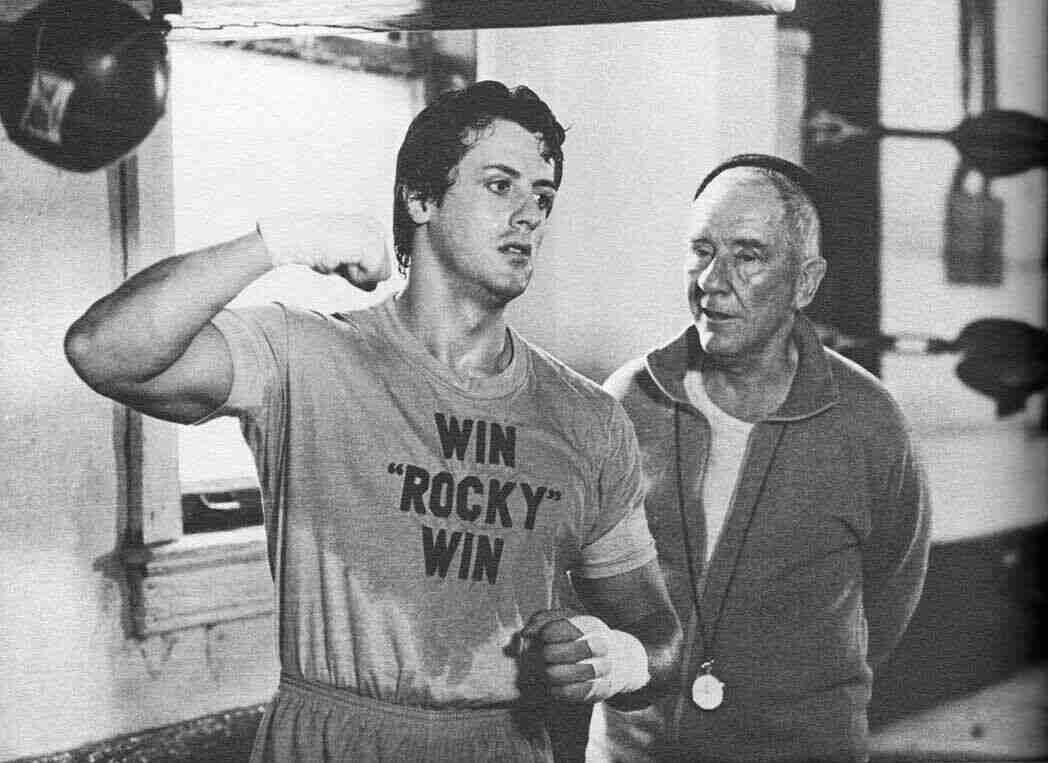
Mickey Goldmill wasn’t just any boxing trainer—he was old-school, no-nonsense, and tougher than a two-dollar steak. He played a massive role in shaping Rocky Balboa from a local club fighter to a world champion, pushing him with brutal training and even harsher words. Played by the legendary Burgess Meredith, Mick had a voice like gravel and a heart buried under layers of grumpiness. He chewed Rocky out constantly, but deep down, he was the ultimate mentor—because if Mickey was yelling at you, it meant he cared.
Now, about Mickey’s mysterious past—his birth year? Depends on which Rocky movie you’re watching. In the original Rocky, he says he’s 76 years old in 1975, which would put his birth year at 1899. But in Rocky III, his headstone says 1905. So, did Mickey lie about his age to fight earlier? Did the Rocky timeline get a little funky? Who knows, but either way, Mickey was ancient, wise, and packed with experience.
Mickey’s Boxing Career: A Fighter Through and Through
Mickey Goldmill wasn’t just some washed-up old trainer—this guy lived and breathed boxing. He fought professionally in the 1920s, back when the sport was pure grit and toughness, and he earned a reputation as a brawler who didn’t back down from anyone. He tells Rocky in 1975 that he’s been “in this racket for 50 years”, which would mean he started around 1925. But hold on—Mick also brags about knocking Guinea Russell out of the ring on September 14, 1923, the same night Luis Firpo sent Jack Dempsey flying through the ropes. So which is it? The Rocky timeline is about as accurate as one of Paulie’s financial decisions, but hey, it’s all part of the fun.
Dempsey vs. Firpo: The Fight That Defined an Era
Now, about that Dempsey vs. Firpo fight—this was one for the ages. It was the first time a Latin American challenged for the heavyweight title, and it went down in history as Ring Magazine’s Fight of the Year in 1923. The iconic painting Dempsey and Firpo by George Bellows? That’s straight-up boxing Americana—showing the moment Firpo knocked Dempsey clean out of the ring. But like all great underdog stories, Dempsey climbed back in and finished the fight, taking Firpo down.
Mickey might not have fought on the same stage, but he had the heart of a champion—he just never got the shot. He always said his biggest mistake was never having a manager, and that’s why he never got a crack at the title. He took his lumps, racking up injuries, including that classic cauliflower ear—a battle scar from years of getting whacked.
Mickey’s Weight Class: Small But Tough as Nails
And let’s talk weight class—because Mickey Goldmill wasn’t some towering heavyweight. According to Rocky Legends (the video game), young Mickey stood 5’8”, had a 68” reach, and weighed in at 146 lbs. That puts him right at the top end of the lightweight division, though he could have easily fought as a featherweight in his early years. So while he may not have had Dempsey’s size, Mickey relied on speed, skill, and sheer toughness to make a name for himself.
But Mick never forgot where he came from. He carried around a crumpled old photo of himself from his fighting days, proof that once upon a time, he was young, hungry, and ready to take on the world. As he put it, “I’ve got pain and I’ve got experience.” And in Mickey’s book, that’s what makes a real fighter.
Screenwriter Carl Kirshner wrote a screenplay titled Angel on My Shoulder, which serves to explore the backstory of Mickey Goldmill’s early life. This story delves into Mickey’s days as a young fighter, his struggles in the sport, and his transition into coaching. It provides a deeper look at how Mickey’s experiences shaped his grizzled and relentless approach to training future boxers, including Rocky Balboa.
Sweat, Blood, and Wisdom: Inside Mighty Mick’s Boxing Gym
Mighty Mick’s Boxing Gym wasn’t some fancy, high-tech training center—it was pure, old-school, blue-collar Philly boxing. The place smelled like sweat, leather, and bad decisions, but for Mickey, it was home—literally. He didn’t just run the gym, he lived above it, making it his fortress of solitude where he could train fighters all day and probably yell at pigeons out the window at night.
After hanging up his gloves, he opened the gym and turned it into a factory for tough fighters, molding scrappy nobodies into warriors. Out front, a big red sign loomed over the entrance, showing off a young, fearless Mickey Goldmill in his prime—a reminder that he was once a real deal brawler before he became the grumpy old guy barking orders. Inside, it was all about hard work, no shortcuts, and plenty of insults. If you weren’t ready to train until you puked, you might as well walk back out the door.
Now, we don’t know exactly when Mighty Mick’s Gym officially opened its doors, but we do know it was around at least by 1965. Why? Because Rocky seems to have known Mickey for at least a decade by the time we meet him in Rocky (set in 1975). That means for at least ten years, Mick was out there, training fighters, yelling at them to keep their hands up, and probably throwing them out the door if they didn’t have what it took.
And when it came to Rocky? Mickey wasn’t exactly rolling out the red carpet. He saw Balboa as a wasted talent, just another club fighter going nowhere fast, even kicking him out of his locker to make room for someone with “potential.” But then, fate knocked on the door—Apollo Creed handpicked Rocky for a once-in-a-lifetime title shot. Suddenly, Mickey saw an opportunity for redemption, not just for Rocky, but for himself.
Their confrontation at Rocky’s apartment? Pure cinematic gold. Mickey begged, Rocky raged, doors slammed—until finally, the underdog realized he needed Mick in his corner. Chasing the old man down the street, they sealed their partnership, and from that moment on, Mighty Mick’s Gym became the birthplace of a legend.
Old-School Training: Unconventional Methods That Built a Champion
Mickey Goldmill didn’t believe in fancy equipment or cutting-edge science—he trained fighters the old-fashioned way, with sweat, grit, and a whole lot of yelling. His methods may have looked bizarre, but they worked.
One of his most famous techniques involved tying a string between a fighter’s feet. It wasn’t just some gimmick—Mickey swore by it. “Rocky Marciano had the same problem, and this string cured it,” he told Rocky. The idea was simple: if a fighter could move and punch without snapping the string, they had balance. Balance meant power. Power meant victory. And victory meant you weren’t getting your face punched in.
Then there was the chicken chase, which Rocky initially laughed at—until he realized how impossible it was. “If you can catch this thing, you can catch greased lightning,” Mickey barked. Speed and reflexes win fights, and nothing trains a fighter’s footwork like trying to grab a frantic bird with your bare hands.
And, of course, there was Mickey’s golden rule: No sex before a fight! Why? Because, in his words, “Women weaken legs!” He was convinced that staying away from temptation kept a fighter strong, focused, and full of energy for the ring. Science may not agree, but Mickey didn’t care—his fighters followed the rule.
Mickey’s training wasn’t pretty, and it wasn’t easy, but it built warriors. Just ask Rocky Balboa.
Death Couldn’t Stop Mickey from Training Rocky
Mickey’s death in Rocky III hit like a gut punch. Just before Rocky’s fight with Clubber Lang, Mickey suffered a fatal heart attack. Rocky was shattered, breaking down in the locker room, unable to face the reality that the man who had molded him into a champion was gone. But here’s where Mickey proved he was larger than life—because even in death, he never really left.
Mickey was given a Jewish burial, a nod to his heritage. In Rocky III, we see Rocky standing over his coffin, paying his respects at the cemetery. This location, filmed in Los Angeles, California, remains an important piece of Rocky history.
Rocky carried Mickey’s words with him. That raspy voice still echoed in his head, pushing him, calling him a bum when he needed tough love, reminding him to find the Eye of the Tiger when he lost his edge. Mickey was the kind of guy who wouldn’t let something like dying stop him from coaching. Whether it was in memories or flashbacks, he was always there, yelling at Rocky to get back in the ring.
Now, let’s talk Rockyverse time travel for a second—Mickey supposedly dies at 76 years old, but he also told Rocky he was 76 in the first movie! Either Mickey aged in dog years, or the timeline got a little fuzzy. It’s just another one of those quirks that make the Rocky series what it is.
Mickey’s Legacy
Mick’s influence didn’t stop just because he wasn’t around to yell at Rocky anymore. In Rocky V, we find out that Mickey left Mighty Mick’s Gym to Rocky Jr., keeping his legacy alive and ensuring that the place where so many fighters got their start stayed in the Balboa family. Even after he was gone, Mickey’s spirit was still in every punch thrown in that gym.
Mickey Goldmill wasn’t just a trainer—he was the backbone of Rocky’s journey, a man whose lessons continued to shape the world of boxing long after he was gone.