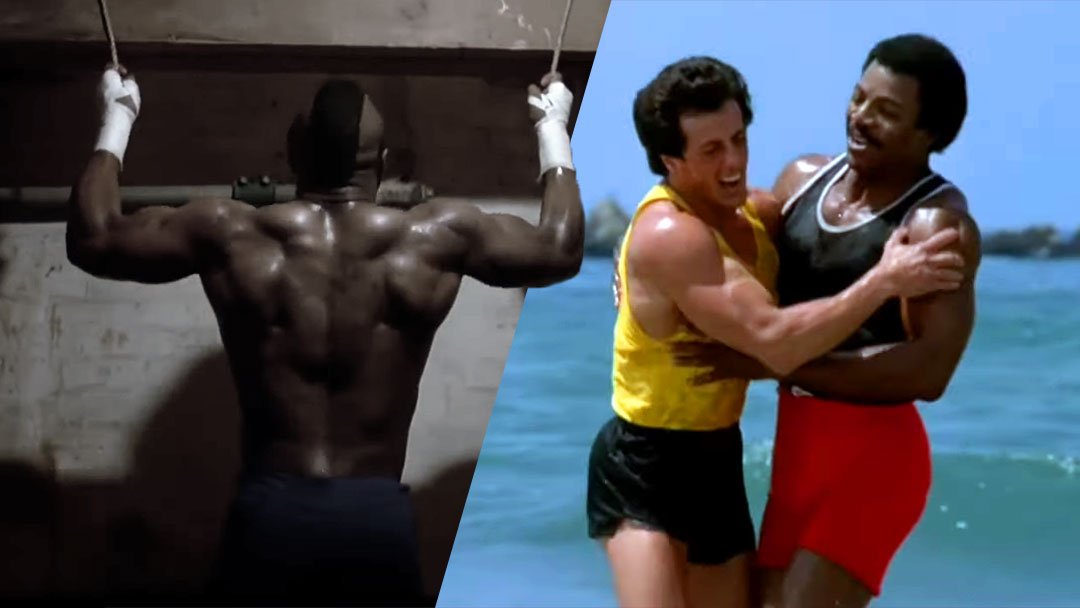
From Mick’s Gym in Philly to the blistering sands in Creed II, medicine ball exercises have been a core part of the Rocky franchise’s training montages. They’re not just visuals—they reflect real boxing methods built for strength, durability, and explosive power.
In the original Rocky, there’s a blink-and-you-miss-it moment during the “Gonna Fly Now” montage. Trainer Mike (played by Jimmy Gambina, who trained Stallone off-screen) drives a brown leather medicine ball into Rocky’s stomach. That shot’s no stunt—it’s abdominal conditioning. It teaches the body to take punishment and tighten under impact.
In Rocky II, Rocky and Johnny stand back-to-back in Mick’s gym, passing a medicine ball left to right. That twisting movement sharpens core rotation and punch torque.
Then, in Rocky V, a heavier, darker brown ball gets thrown with force between Rocky and Tommy Gunn in the ring. That kind of drill builds upper-body power and teaches control during high-speed exchanges.
In Rocky Balboa (2006), Rocky pushes through medicine ball one-arm push-ups on the chalk-dusted floor of the South Philly Lifting Club. At age 59, he’s focused on power—what Duke calls “blunt force trauma”—and these push-ups help him build the raw strength behind those hurtin’ bombs.
In Creed II, the tradition continues. During the intense desert montage, Rocky pounds a rugged black 10-pound medicine ball into Adonis Creed’s core. It’s one of the film’s most brutal moments—and one of the most accurate portrayals of real boxing bodywork.
The Function of the Medicine Ball in Boxing Training
Medicine ball exercises serve multiple roles in boxing. They help build strength, sharpen movement, and improve resilience. The term “medicine ball” dates back to ancient times, when it was used for rehabilitation and general health—hence the word “medicine.”
For boxers, core strength is not just about aesthetics—it directly affects fight performance. Twisting, slamming, and throwing movements mirror actions inside the ring. When done regularly, they increase rotational force and help transfer energy from the lower body into each punch.
Why Medicine Ball Training Works So Well
Medicine ball exercises activate multiple muscle groups at once. That’s why they’re considered functional movements. You don’t just work your abs—you also train your shoulders, hips, and stabilizers. These exercises build:
- Explosive Power: Ball slams and throws require full-body engagement and quick energy output.
- Functional Strength: Unlike static weights, the medicine ball adds resistance to dynamic movements, mimicking real-world tasks.
- Better Posture: Core stabilization helps improve alignment and body awareness during daily activities.
- Bone Density: Plyometric exercises—like jumps and slams—increase bone strength through mechanical stress and ground reaction forces.
This isn’t just about getting a six pack. These workouts build real physical capacity—from balance and coordination to raw power. That’s what makes them ideal for fighters, athletes, and everyday folks alike.
Real Fighters Who Used the Medicine Ball
World Champions like Rocky Marciano trained with the medicine ball daily. Marciano’s camp routinely included partner drops—where the ball was thrown into his midsection while he lay on the ground. This is similar to Johnny’s pounding on Rocky’s abs in Mickey’s Gym.
Modern fighters continue the tradition. Canelo Álvarez uses rotational throws and rebound drills. Tyson Fury incorporates full-body slams to improve cardio and hand speed. The application hasn’t changed. What worked in the 1950s still works today.
How to Train at Home with a Medicine Ball
You don’t need a boxing gym to train like Rocky. Medicine ball exercises are space-efficient and simple to learn—but brutally effective. Here are four fundamental movements to work into your routine.
- Russian Twists: Sit on the floor, feet elevated. Rotate side to side with the ball. This move hits your obliques and improves torso control.
- Overhead Slams: Raise the ball overhead and slam it to the ground as hard as possible. It builds upper-body speed and total-body power.
- Wall Throws: Stand a few feet from a wall and throw the ball forward. Catch it on the rebound. This builds coordination and upper-body explosiveness.
- Stomach Drops (Partner Drill): Lie flat while a partner drops the medicine ball onto your core. This classic boxing drill trains body conditioning and tension control.
Use these moves to build your own custom core session or combine them with footwork drills for a full-body circuit. They’re beginner-friendly but can scale up fast.
What a Medicine Ball Workout Actually Looks Like
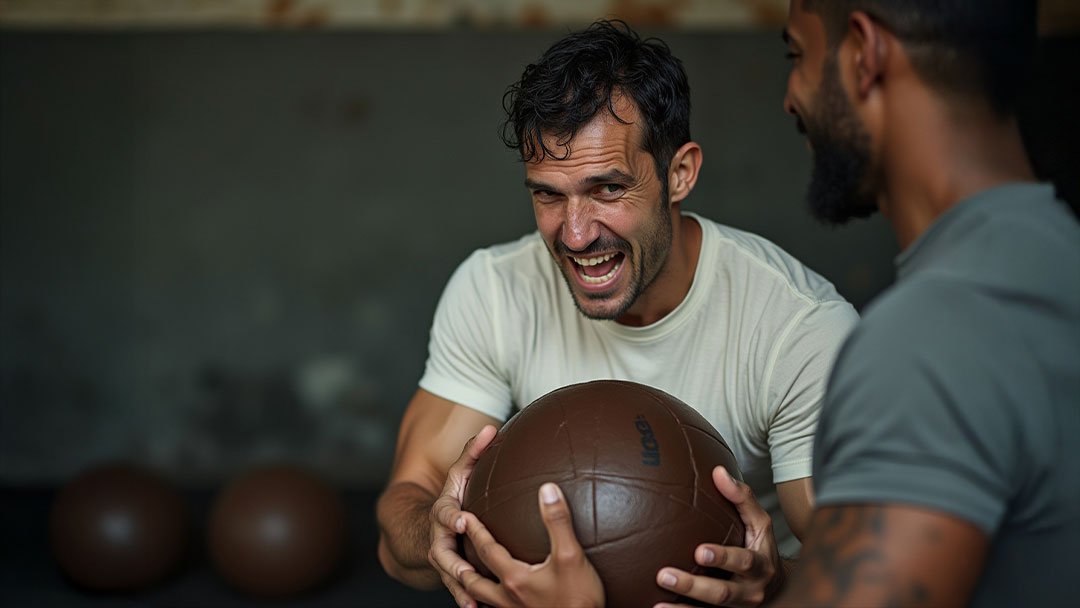
Seeing Rocky get slammed in the gut with a medicine ball is one thing. But what does this training actually look like for the average person? Here’s a fast, high-output circuit that hits the same muscles, without needing a ring or a coach.
Each exercise below is performed for 20 seconds. Complete all three, then rest for 20 seconds. That’s one round. Aim for five total rounds.
This format keeps your heart rate up, your core firing, and your shoulders working. If you’re a guy, try a 10 to 12-pound ball for maximum intensity without sacrificing control.
Medicine Ball Core Circuit (5 Rounds)
| Exercise | Instructions | Focus |
|---|---|---|
| Seated Reach-Throughs | Sit down, lift feet slightly, and pass the ball under each leg, alternating sides for 20 seconds. | Lower abs, coordination |
| Wall Sit Crossovers | Hold a wall sit. Twist and pass the ball across your body side to side for 20 seconds. | Obliques, quads, shoulders |
| Reverse Crunch with Ball | Lie flat, hold the ball between your legs, and crunch your knees toward your chest for 20 seconds. | Lower core, hip flexors |
| Rest: 20 seconds after each round. Complete 5 total rounds. | ||
Training Smart: Risks and Guidelines
Like any intense training tool, medicine balls can be misused. Here’s how to train smart:
- Start with lighter weights (6–10 lbs) if you’re new to dynamic core work.
- Master your form before progressing to heavier balls or faster reps.
- Always warm up thoroughly—especially if doing plyometric drills like slams or jumps.
- Listen to your body. If you feel pain (not to be confused with a burn), stop immediately.
- Use a timer app or round clock to keep rest intervals consistent and short.
Medicine ball workouts are scalable and safe when approached with control and proper technique. And unlike machines or big equipment, they’re accessible to nearly everyone.
Choosing the Right Medicine Ball for Your Goals
Picking the correct weight is important. If the ball is too heavy, your form breaks down. If it’s too light, you miss the full training effect.
- 6–8 lbs: Ideal for beginners and core endurance drills.
- 10–15 lbs: Best for slams, wall throws, and partner drills.
- 20 lbs and up: Suitable for advanced power training and impact work.
In Creed II, a 10-pound black medicine ball was used for abdominal conditioning. Creed III ups the weight—a 20-pound brown leather ball was used during the film’s production. Back in Rocky II, Mickey’s gym features a brown leather medicine ball, consistent with the rugged style used in traditional boxing gyms.
Final Thoughts: Why Medicine Ball Exercises Matter
Medicine ball exercises remain one of the most efficient ways to build real-world strength, core stability, and impact tolerance. These aren’t flashy trends—they’re foundational tools in fight training, used by pros from Rocky Marciano to modern champs like Canelo Álvarez.
Used consistently, medicine ball training helps develop the kind of power that translates directly to the ring—or any sport. It builds rotational strength for harder punches, reactive control for defensive movement, and midsection toughness to absorb blows. And when paired with other classic boxing tools like jump ropes, it delivers a full-body conditioning routine that’s brutally effective and endlessly scalable.
This style of training isn’t just for fighters, either. It’s for anyone who wants to move better, train smarter, and build real function—not fluff. Whether you’re looking to hit harder, last longer, or carve out a fighter’s core, this is the place to start.