When it comes to fight training on film, nothing casts a longer shadow than the original Rocky montage from 1976. It’s been parodied, imitated, and studied, but never truly topped. That two-minute sequence where Rocky Balboa transforms from club fighter to serious contender isn’t just memorable — it’s mechanically brilliant and technically groundbreaking.
The Rocky 1 training montage stitched together a fighter’s journey using Philadelphia’s streets as a gym and Bill Conti’s score as a metronome. It’s the moment the film stops telling us Rocky’s improving — and shows us.
Earlier Boxing Films Had Montages — But None Felt Like This
Montages existed in boxing cinema before Rocky. Films like Body and Soul (1947) and Champion (1949) used the technique to speed through time and show physical improvement. But none made the audience feel like they were part of the action.
That shift came from a piece of equipment few knew existed at the time — the Steadicam. Invented by Garrett Brown and operated by him on set, the Steadicam followed Sylvester Stallone as he sprinted through South Philly’s streets, under bridges, and up the steps of the Philadelphia Museum of Art. The shots are seamless. The movement is fluid. It doesn’t feel like a camera’s there at all. That innovation let viewers experience the effort in real time — and it changed the way training scenes were shot from then on.
Key Locations and Moments in the Rocky 1 Training Montage
The Rocky 1 training montage unfolds across a sequence of authentic Philadelphia locations that trace Rocky’s physical rise and the city’s visual character. What’s cooler still – you can visit most of them today.
The montage opens at dawn in the railroad yard. Sunrays cut across the frame, flaring into the camera lens as Rocky jogs with a brick in each hand. The distant sound of the elevated train, empty surroundings, and early light set the tone — cold, quiet, and full of building power.
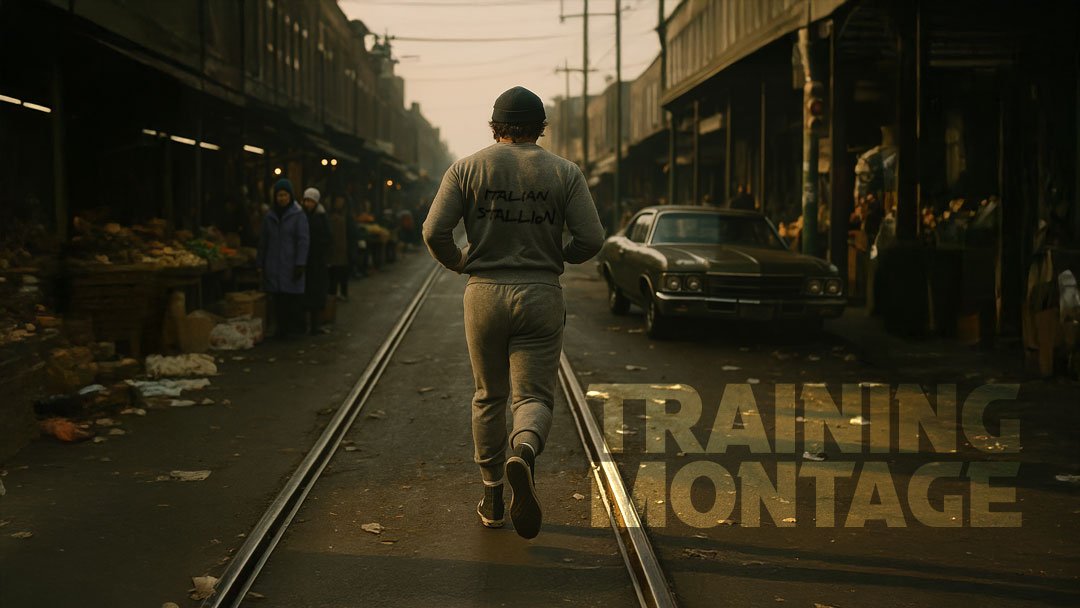
From there, Rocky charges through the Italian Market. He darts between produce stands, past vendors and crates, giving the montage a jolt of movement through one of the city’s most lived-in streets. The route continues beneath a stone-arched bridge along the river. The frame tightens and darkens — a stretch of solitude before the music builds.
Inside Mickey’s gym, brief shots mark progress: the speed bag, pushups, sit-ups, and medicine ball work. The details of these exercises unfold later, but in the montage, they flash by as part of a larger rhythm, shot with speed and intent.
In Paulie’s meat packing plant, Rocky pounds sides of beef bare-knuckled in the cold. The echoes in the locker, the sharp thud of flesh on flesh — it’s one of the most unforgettable images in the series. Stallone’s punches here were real, and the damage to his hands was permanent.
The run continues along the river, where the Moshulu ship appears in the background — a steady presence in an otherwise empty stretch. Finally, Rocky sprints up the steps of the Philadelphia Museum of Art. At the summit, he turns to face the city, arms raised. It’s the payoff — visually and emotionally — of every location that came before it.
Inside the Workout: What the Montage Shows — and What It Trains
The first few notes of “Gonna Fly Now” hit at the start of this 3:13 montage— the trumpets are quiet at first, just beginning to rise. As the horns swell, so does Rocky’s effort. What follows is a sequence of real conditioning movements, each building on the last, each chosen to push the body and sharpen the fighter.
Running with Bricks in Hand
Rocky runs with a brick in each hand, lifting them as he moves. The bricks act as resistance, turning a standard run into a weighted grind. Every lift targets the shoulders and forearms while engaging the core to keep balance. This kind of movement builds arm stamina and punching endurance — essential for carrying power into the later rounds of a fight.
Speed Bag Work
Rocky stands in rhythm with the speed bag, striking clean and fast. His hands move like a metronome — tight, sharp, no wasted motion. The speed bag builds hand-eye coordination and fine motor speed. For boxers, it’s as much about timing and breathing as it is about speed.
Heavy Bag Training
The camera lingers as Rocky throws tight combinations on the heavy bag. Mickey said the Stallion fights like a “goddam ape”, but there’s rhythm to his punches now. He’s not just throwing — he’s placing shots. The bag swings and rebounds with every impact. Heavy bag training builds stamina and technique together. It shows that Rocky is learning to throw with both power and control.
Sit-Ups on the Ring Apron
Inside the gym, Rocky lies back over the edge of the ring apron with his upper body hanging down. No equipment, no pads — just sit-ups done with raw effort. His hands are crossed behind his head, legs anchored. The movement focuses on strengthening the rectus abdominis, but more than that, it hardens the mindset. There’s no break, no soft landing, just repeated contraction until the next cut.
One-Arm Pushups
On the ring canvas, Rocky switches to one-arm pushups. One arm is tucked behind his back, the other pressed flat to the mat. Michael and Mickey kneel behind him, counting out loud. They push him past 40, edging toward 50 before the scene cuts away. The form is clean and deliberate — chest to the mat and back up. This isn’t cinematic fluff. It’s a legitimate feat of strength that targets the chest, triceps, core, and shoulder stability.
Medicine Ball to the Abdomen
Later in the montage, Rocky returns to the ring apron. This time, he braces himself while Michael stands in front of him with a medicine ball. With full force, Michael drives it down into Rocky’s stomach. The drill doesn’t build muscle — it builds toughness. It conditions the abdominals to take repeated impact, simulating body blows from a heavy puncher.
Punching Hanging Meat
And this is the piece of the montage that is as iconic as anything. Inside the meat packing plant, Rocky squares up to a side of frozen beef and lets loose. He mixes straights and hooks, driving bare knuckles into bloodied flesh. Stallone didn’t fake the hits — he struck so hard, so often, that his knuckles permanently flattened during filming.
This scene sells more than toughness. It sells weight, texture, and grit. Every impact echoes through the cold storage. There’s no choreography here, just repetition and pain. It’s one of the rawest images in the entire series. Years later, Rocky returns to this exact method in Rocky Balboa, proving the old ways still have a place when the stakes are personal.
The Sound of the Climb: Bill Conti’s Score Pushes It Forward
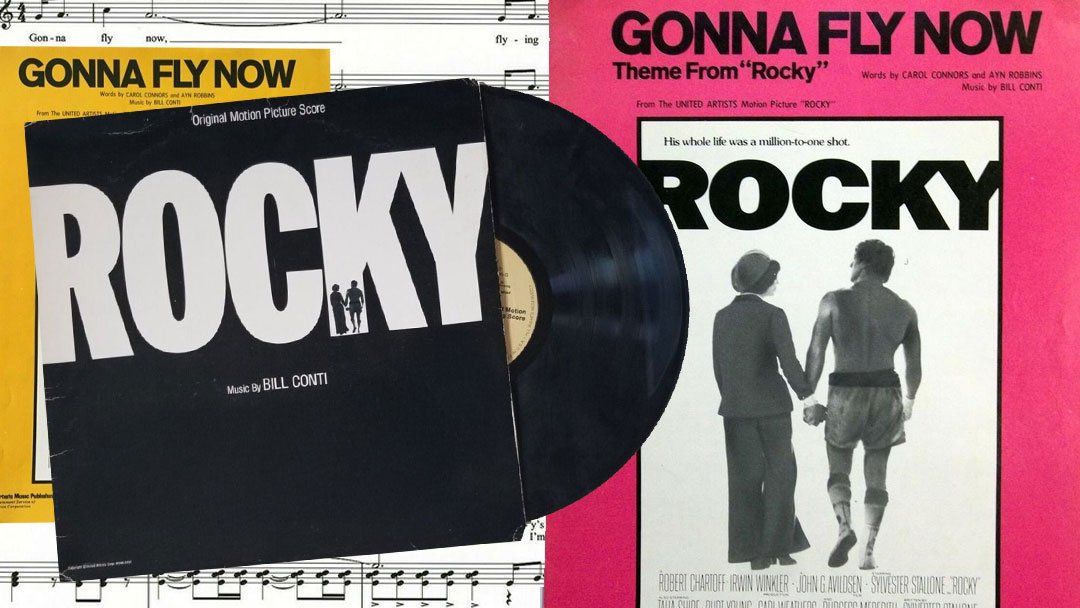
“Gonna Fly Now,” written by Bill Conti with lyrics by Carol Connors and Ayn Robbins, gives the montage its pulse. It starts low and steady, matching Rocky’s first slow jog. As the music builds with brass and choir, the editing speeds up. By the time he charges the steps, the horns hit their peak.
There’s no dialogue. No voiceover. Just movement and music — which makes every moment feel earned. The track would go on to hit No. 1 on the Billboard Hot 100 in July 1977. It remains one of the most recognizable training songs in film history.
Why the Rocky 1 Training Montage Still Works
The sequence works because it’s grounded in real emotion. Every frame tracks Rocky’s progress not just in strength, but in mindset. He begins stiff and uncertain. He ends with rhythm, speed, and posture — standing tall on the steps like he belongs.
It also invites participation. Audiences don’t just watch — they feel it. And every time they rewatch it, it still hits. You get the itch to move. To sweat. To push yourself.
So if you’re sitting still right now, don’t. Get up. Go run a few blocks. It doesn’t matter how fast or how far — it just matters that you start. The hardest part is lacing up your shoes.